Ghana
Why we work in Ghana
Ghana is one of Africa’s fastest growing economies, but much of its population lives in extreme poverty. Most people rely on the land and farm their own food, which means when there are droughts or floods they suffer severe food shortages.
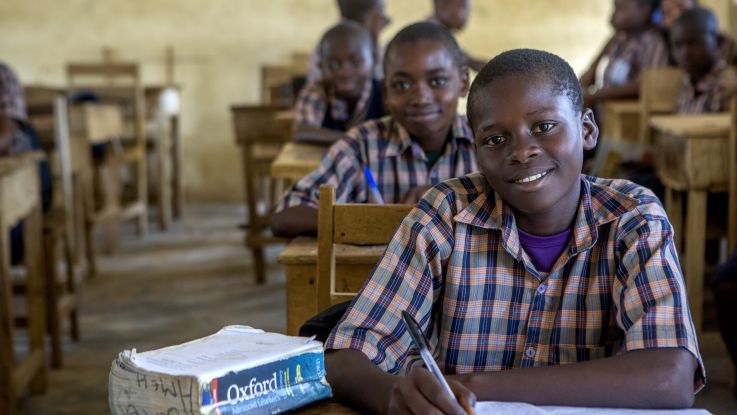
Many children in Ghana don’t get a good education, often not finishing secondary or even primary school, because classes are often overcrowded, schools don't have water or toilets, and trained teachers and school books are in short supply.
Women and girls' rights in Ghana
Despite the law, women and girls all over Ghana often face violence, discrimination and abuse.
It's common for girls to be forced to have female genital mutilation (FGM) and be married against their will, and for women to be accused of witchcraft and banished to live in ‘witch camps’.
What we do in Ghana
To protect girls from being kidnapped for marriage we support Community Anti-Violence Teams, known as COMBAT squads, to take action against abuse and educate local people about state laws. In 2013 COMBAT teams rescued 49 girls who had been abducted.
We put pressure on the government to close witch camps and help reintegrate women into their communities. In December 2014 we organised the closure of the Bonyasi Camp.
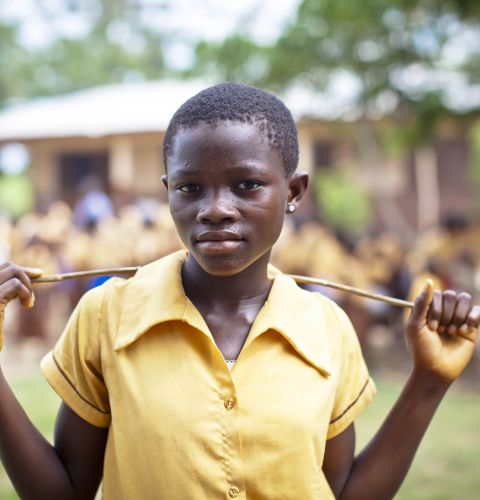
Our Girls’ Clubs teach girls about their rights and support them to stay in school, and by providing equipment - from school books to solar lamps - we help children to learn.
Responding to the Covid-19 pandemic
ActionAid reached more than 11,000 people in Ghana with life-saving supplies during the pandemic, while our awareness-raising projects, like radio and TV broadcasts about the prevention of the virus, reached over eight million.
Our response included distributing thousands of face masks, food packages and hygiene kits in vulnerable communities.
Stigma against survivors of Covid-19 (and their families) emerged as a major issue in Ghana; as a result we carried out wide-ranging public awareness projects, like TV broadcasts and social media campaigns, to prevent the spread of misinformation.
We also worked to support women and girls by running 11 women-friendly spaces across Ghana, and distributing menstrual products to those in need.

Supporting women accused of witchcraft in Ghana
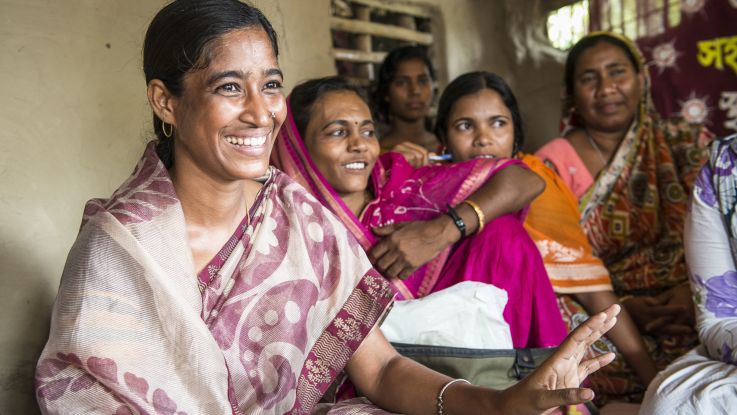
Ayishetu was accused of being a witch after her neighbour’s daughter fell ill, and Ayishetu was cast out from her village. She ended up in Gambaga camp and was separated from her family for almost three years.
It’s thanks to the Go Home project, supported by ActionAid, helping women escape and reinitegrate back home, that Ayishetu was eventually re-accepted by her community and able to live a normal life again.
"It wouldn’t have been possible for me to come home without the project," she explains. "Accusations of witchcraft don’t just go away, but Go Home helped persuade my community that the way they acted towards me was wrong".
Donate to help support our work in Ghana40-year-old Ayishetu and her friends in Kolinvai village, Northern Ghana
Jane Hahn/ActionAid

Solar lamps to help children study
Without electricity in her village, Ruth struggled to study in the evenings. She and her friends came up with the idea of using solar lamps, and with ActionAid's support they now gather each evening to do their homework.
10-year-old Ruth explains: "We will always be grateful to ActionAid for these books and solar lamps because now we study seriously at night.
"More parents in this community are now taking their children to school because of the way they see us studying seriously at night with our solar lanterns. They have really helped us."
Learn more about our work improving children’s educationRuth, 10, studying with her friends in Ghana
,ActionAid
Footnotes
- 1https://data.worldbank.org/indicator/SP.POP.TOTL?locations=GH
Page updated 3 March 2023