Myanmar
Why we work in Myanmar
Myanmar is home to 135 ethnic groups. In recent years, the country has experienced rapid change. A liberalisation process, which began in 2010, has seen more than 40 years of military rule give way to democracy.
Myanmar has made significant progress in recent years in reducing poverty. But one quarter of the population still live in poverty, and another third of people are highly vulnerable to falling into poverty in the future.4
Women’s rights and poverty in Myanmar
Opportunities for ordinary women in Myanmar remain limited. Women lack adequate access health services, and there is still gender inequality in education access.
Despite anti-trafficking laws, human trafficking remains a significant issue; in many cases women are trafficked as 'brides'.5
Meanwhile, Myanmar’s poorest people are particularly vulnerable to climate change, and are experiencing more frequent floods, droughts, and cyclones.
In 2015, heavy rains brought intense flooding and landslides to Myanmar, displacing over 1.6 million people.

"I cannot express how grateful I am for your help. Your donation and support are my answered prayers. Thank you. Thank you."Daw Than Than Tint rebuilds her life after conflict and earthquake, turning loss into hope for her family.
What we do in Myanmar
ActionAid works to tackle violence against women in Myanmar, including by training community paralegals in basic legal skills, and providing free legal aid to women who have survived violence, so that perpetrators can be held to account.
To change attitudes, we train male community leaders in cultivating zero tolerance policies toward violence among their male networks.
We also train government staff, including the police force, on the implementation of laws and policies designed to prevent violence against women.
Supporting women’s economic empowerment
ActionAid helps women in Myanmar to set up their own small businesses, and develop the skills and capacity they need to escape poverty.
We support farmers to set up self-help business groups, which provide access to seedbanks and loans on a revolving basis so they don’t have to rely on moneylenders with high interest rates.
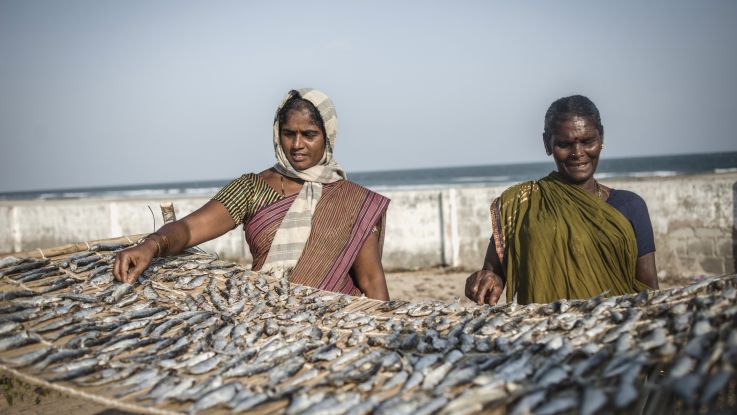
And we support fishers and farmers with the skills and tools they need to become resilient to earthquakes and disasters as the climate changes.
Disasters in Myanmar
Rohingya refugee crisis
Since violence erupted in Myamar's Rakhine State in August 2017, more than 1,004,000 Rohingya people have fled Myanmar, crossing the border into Bangladesh where they're living in makeshift camps in Cox's Bazar. Over 75% of the Rohingya refugee population are women and children with about 500,000 Rohingya children living in the camps.
Food insecurity in the camps is at crisis levels, having increased dramatically since 2022 and food rations have reached a critical point. As of February 2025, more than 15% of children in the camps are now malnourished; these are the highest levels recorded since the mass displacement of Rohingya 6.
ActionAid is working in Cox’s Bazar with a full-scale humanitarian response that has reached at least 60,000 Rohingya refugees with emergency food, clean drinking water and hygiene kits including sanitary products, soap and clean underwear.
In the 2024 monsoon season heavy rainfall impacted refugee camps in this area. Three lives were lost and more than 800 homes were destroyed due to landslides and flooding.
Read more about the Rohingya refugee crisis, and find out how you can help

Rebuilding after crisis
Daw Than Than Tint, 59, lives in Tel Taw village in Mandalay district. The daughter of blind parents, she began working from a young age to support her family. Her mother lost her sight to smallpox, and her father was blinded in one eye by a bomb explosion. Years later, Daw Than Than Tint faced further hardship when her husband left her, leaving her to raise their daughter alone.
To survive, she sells traditional snacks such as Burmese fritters and Ngacheik purple rice, cycling daily to nearby villages on an old bicycle. Despite living with diabetes, rheumatoid arthritis and chronic knee pain, she works every day because missing work means no income. Ongoing conflict, rising inflation and a recent earthquake have sharply reduced her earnings. The earthquake destroyed her home, forcing her and her daughter into displacement. With support from Housing Now’s rebuilding programme, Daw Than Than Tint was able to rebuild. Today, she has a safe home once again.
The news felt surreal; I was overjoyed and could hardly believe my luck. I cannot express how grateful I am for your help. Your donation and support are my answered prayers. Thank you. Thank you."
Daw Than Than Tint rebuilds her life after conflict and earthquake, turning loss into hope for her family.
Aung Htay Hlaing/ActionAid

After the 2025 earthquake, women and children in Myanmar find safety, support and strength through community-led safe spaces.
ActionAid Myanmar
Creating safe spaces after the 2025 earthquake
After the devastating 2025 earthquake in Myanmar, women and children faced heightened risks of violence, trauma and isolation, alongside the loss of homes and livelihoods. In response, ActionAid’s partners prioritised creating safe spaces where women, many now sole providers of their households, could access mental health care, peer support and practical workshops.
Mi Mi Tun was one of the first volunteers to arrive at an emergency camp in Mandalay. Through activities that supported women and brought moments of joy to children, she helped restore a sense of safety and hope.
We came here to help encourage the children — to bring them some joy and help them find strength. Despite everything, there’s this spirit of resilience. This attitude of we’ll keep going, we will survive this."
Footnotes
- 1 https://databankfiles.worldbank.org/public/ddpext_download/poverty/33EF03BB-9722-4AE2-ABC7-AA2972D68AFE/Global_POVEQ_MMR.pdf
- 2 https://reliefweb.int/report/myanmar/myanmar-three-years-devastating-under-reported-war
- 3 https://reliefweb.int/report/myanmar/myanmar-three-years-devastating-under-reported-war
- 4https://www.mm.undp.org/content/myanmar/en/home/presscenter/articles/2019/mlcs-poverty-report.html
- 5https://asiapacific.unwomen.org/en/news-and-events/stories/2019/01/tackling-human-trafficking-in-myanmar
- 6
https://www.unicef.org/press-releases/27-cent-surge-number-children-admitted-severe-acute-malnutrition-treatment-rohingya#:~:text=DHAKA/COX%27S%20BAZAR%2c%20Bangladesh%2c%2cmore%20young%20children%20into%20life-
Page updated 17 April 2026