Female genital mutilation (FGM)
Can FGM be ended?
A lot of progress has been made over the past two decades to end FGM - global rates of FGM prevalence have fallen everywhere, and particularly dramatically in East Africa.
However, with population rates increasing, the absolute numbers of women and girls affected by the practice continue to rise – with an estimated 3 million girls at risk every year.
There is now more evidence available on what works to end the practice and more political will and investment in stopping it.
The progress on ending FGM has been driven by feminist activists and grassroots organisations in affected communities.
ActionAid believes that we can end this practice within a generation. To do this, we need to work with whole communities to establish an open dialogue and change attitudes and behaviours. We are working in partnership with community leaders and with women’s rights networks and activists to help bring an end to this practice.
ActionAid provides direct support to girls and women escaping violence through our safe spaces and safe houses.
ActionAid also provides girls' clubs where girls learn about their rights, gain confidence, build their self-esteem, and learn valuable life skills.
ActionAid provides training to community and religious leaders in the specific skills they need to speak out and influence others so that eventually whole communities say no to FGM.
Why does FGM happen?
FGM is a harmful traditional practice, a social norm, and a form of violence against women and girls.
The reasons for practising FGM are complex. It is a practice that goes back 2000 years, and it is deeply embedded in social, economic, and political structures.
FGM is illegal in many countries, including the UK, but laws are not always well-enforced and not always known about.
In some cases, communities are aware of the law but choose to keep practicing FGM as it is understood to be a social obligation and a necessary rite of passage for girls.
FGM pre-dates major faiths and is not required by any one religion. However, it is practised among various religious groups, under the misconception that it is a requirement.
Many families consider FGM as a necessary part of upholding family honour and tradition and a way of maintaining cleanliness and hygiene.
Men and boys often grow up expecting that they will marry someone who has undergone the procedure and girls may want to be cut due to peer pressure, fear of social exclusion, and where it is a precondition for marriage.
Refusing FGM can have severe social repercussions, including being rejected by one’s family, becoming an outcast, or being denied the right to speak in public.
If a girl refuses FGM, she may be forced to be cut anyway, or run away to escape. This social context is why ActionAid believes in working with the whole community to abandon the practice rather than placing the burden on individuals to refuse the practice.
Types of FGM
The World Health Organisation has classified four main types of FGM.4
- Type I - clitoridectomy: removing part or all of a girl’s clitoris and/or prepuce
- Type II - excision: removing part or all of a girl’s clitoris and the inner labia (lips) with or without removal of the outer labia (excision)
- Type III – infibulation: narrowing of a girl’s vaginal opening by repositioning the labia (lips) to make a seal (with or without cutting of the outer labia)
- Type IV – all other harmful procedures: including pricking, piercing and cauterisation.
All types are a violation of girls’ human rights.
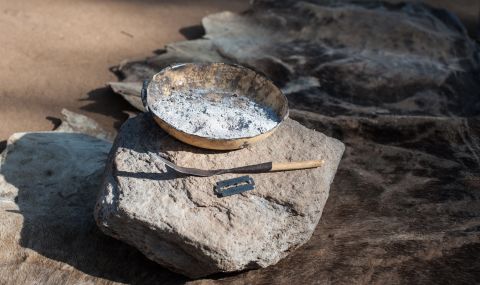
Types of tools used in FGM practices in Pokot, Kenya .

Hodan’s fight for women and girls in Somaliland
Hodan, 22, is a pastoralist living near Hargeisa, Somaliland, with her husband and three young children.
She is part of a women’s group that provides both economic support and a safe space to discuss women’s rights, violence against women and girls, and Female Genital Mutilation (FGM).
As a survivor of FGM, she has become an activist, raising awareness in her village and surrounding communities.
Through the safe space, Hodan has gained knowledge on the dangers of FGM, economic empowerment, and the confidence to educate her daughters and other young girls.
She continues to advocate for change, highlighting the urgent need for support in her community amid widespread food insecurity and the ongoing humanitarian crisis.
In the safe space we raise awareness around female genital mutilation, and every month we have three awareness activities in the community."
Hodan turns her experience as an FGM survivor into activism, empowering women and girls in Somaliland.
ActionAid
What’s ActionAid doing to stop FGM?
ActionAid works in Ethiopia, Ghana, Kenya, Liberia, Senegal, Sierra Leone, Somaliland, The Gambia and Uganda to end female genital mutilation.
- We provide direct support to women and girls who have escaped FGM
- We help communities to learn and openly talk about its damaging effects
- We run youth groups and girls clubs to help girls and boys learn about gender equality and speak out for girls rights
- We train women to form Women’s Watch Groups to report cases of FGM
- We lobby governments to help pass anti-FGM laws
- We campaign for an end to violence against women globally.
322,800
women helped to challenge violence against women and girls and harmful traditional practices like FGM in a single year.
1,080
community-led projects supported women and girls to challenge harmful traditional practices including FGM in a single year.
2,000
members of the ActionAid-supported Kongelai Women’s Network are campaigning to end FGM in Kenya.
Fighting FGM around the world
We believe that we can end FGM in a generation.
Progress is being made – more countries are creating laws banning the practice, and more communities are working together towards collective abandonment.
But there is still much to do to achieve total eradication. ActionAid will continue working in partnership with communities and women’s rights organisations until this practice is stopped, and all girls are able to lead lives of safety, dignity, and equality.
Are you at risk of FGM?
If anyone (yourself, someone in your family or anyone you know) is at immediate risk of FGM call the police on 999.
For further help, the following services may be able to help you:
NSPCC: Free, dedicated FGM helpline
For those who are worried about a child potentially at risk of FGM (or at risk themselves) the NSPCC 24 hour anonymous helpline can provide support 0800 028 3550 or email FGM.Help@NSPCC.org.uk
The Dahlia Project is a specialist service for women and girls in the UK who have undergone FGM, and provide therapeutic support groups
The National Health Service offers specialist FGM support clinics around the country
FORWARD provide information about FGM in the UK, advice services, and also have monthly coffee mornings to share experiences
Footnotes
- 1https://www.unfpa.org/female-genital-mutilation#readmore-expand
- 2https://www.who.int/news-room/fact-sheets/detail/female-genital-mutilation
- 3https://www.forwarduk.org.uk/violence-against-women-and-girls/female-genital-mutilation/
- 4World Health Organisation, 'Eliminating female genital mutilation - An interagency statement'
Page updated 25 August 2026