Ending period poverty and creating period justice
Nearly 1 in 5
girls and women in South Asia reported missing school, work or social activities because of their period between 2017-2023.1
12%
of women and girls aged 15–49 in low- and middle-income countries use reusable menstrual materials.2
700,000
women and girls of menstruating age in Gaza were facing a menstrual hygiene emergency amid conflict, displacement and severe shortages of water, sanitation and menstrual products in 2025.3
Period justice in education
Periods shouldn’t be a barrier to education.
Managing a period should never mean missing a day of school, falling behind in class or feeling unable to participate. But education systems often fail to provide the conditions students need to manage menstruation safely and with dignity.
Period justice in schools means providing pads, but also teaching accurate menstrual health education; providing clean, private toilets; water, soap and safe disposal facilities; and having teachers who are equipped to support students without shame or embarrassment.
ActionAid works with women's rights organisations around the world to improve access to toilets, showers, menstrual products and education for girls about periods and reproduction, so girls can go to school and get the skills they need to break out of poverty and take control of their own lives.
Period justice means making schools work for people who menstruate, not expecting them to adapt to systems that weren't designed with their needs in mind.
What needs to change:
- Education: Everyone should receive accurate, age-appropriate information about menstruation including boys and young men, to challenge stigma.
- Access: Students should be able to get the menstrual products they need, without cost being a barrier.
- Facilities: Schools need clean, safe and private toilets, with water, soap and appropriate disposal facilities.
- Support: Teachers and school staff need training so students can ask for help without embarassment.
- Participation: Periods should never limit someone's ability to learn, take part in lessons, play sport or participate fully in school life.
ActionAid has built safe spaces for girls in schools around the world. These safe spaces help girls manage their periods with confidence and dignity, so they can continue attending school without fear of embarrassment or bullying.
Our girls' clubs and period safe rooms give girls an environment where they can get information and ask questions about periods, sex and pregnancy, so that they are better informed about their bodies.

How ending period poverty improves education
Nyakang, 15, is a South Sudanese girl living in Kiryandongo refugee settlement with her mother.
When Nyakang started her period at 14, she was scared and didn’t have pads. Her mother managed to get her some, and later, she received pads from Razia, which also helped her friends who had none.
Through ActionAid’s reusable pad workshops, Nyakang has learned to make her own reusable pads. She shares these with friends and encourages them to join the workshops, helping other girls manage their periods safely and continue attending school.
Despite her efforts, Nyakang sometimes does not have enough pads due to financial constraints. She says she feels bad when she cannot manage her period properly. When she has pads, she participates fully in school and daily activities without restriction.
Nyakang is aware of her right to education. Inspired by the support she has received, Nyakang dreams of becoming a teacher to help other children and girls like her in the future.
Nyakang is a South Sudanese girl living in the Kiryandongo Refugee Settlement.
Esther Mbabazi / ActionAid
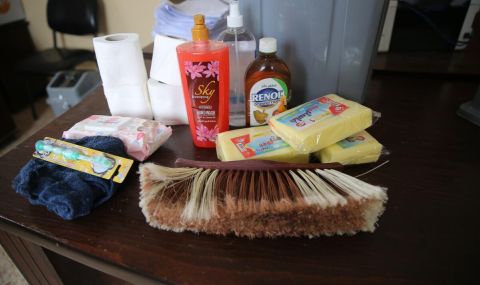
Wefaq Association – a women-led non-governmental organisation in Gaza and partner of ActionAid, distribute hygiene kits to women and girls .
Period justice in emergencies and crises
Periods don't stop during a crisis.
When conflict, disasters or displacement disrupt everyday life, managing a period can become even harder. Access to water, toilets, privacy and period products can be severely limited while fear, displacement and trauma can make an already difficult experience even harder.
In an emergency, menstrual products can quickly become unavailable or unaffordable. Without access to appropriate products, people may be forced to use whatever is available including torn clothing, rags or other improvised materials. These alternatives can be uncomfortable, ineffective and unhygienic. They can also lead to leaks, embarrassment and isolation, adding another layer of stress and indignity to an already difficult situation.
At ActionAid, we work with women and girls to make sure menstrual health is considered from the outset of a humanitarian response not added as an afterthought.
We have distributed menstrual products in crises and disasters including the Nepal earthquakes, the refugee crisis in Greece, Bangladesh floods, the Turkey-Syria earthquakes, refugee settlements in Uganda and during the ongoing Gaza crisis.
Products are distributed through Women Friendly Spaces which are safe spaces established after disasters where women and girls can access support, information and services, including protection from violence.
Our humanitarian work recognises that meeting basic needs is also about choice, dignity and safety. By making menstrual health part of emergency response, we help ensure that periods don't become another barrier to women and girls living safely and participating in their communities, even during a crisis.
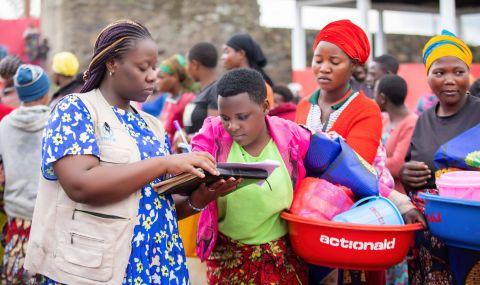
A woman distributing hygiene kits to displaced women in the DRC .

Managing periods during displacement
Maria, 16, is a South Sudanese refugee living in Kiryandongo refugee settlement, where she has lived for the past four years. She had her first period at 15. “My mother gave me pads and told me about periods,” she recalls.
Since then, Maria has attended menstrual health workshops where she learned how to make reusable sanitary pads. Through the sessions, she also gained knowledge about early marriage, teenage pregnancy, and girls’ rights.
Making her own pads has eased financial pressure. “Now I can save money,” she says. Maria also makes pads for friends who cannot afford them and shares what she has learned.
Sometimes they don’t have money to buy pads, so I help them.”
Today, Maria says she has enough pads each month and no longer worries about missing school. The confidence she gained through the workshops has transformed her leadership, she is now Head Girl at her school, supporting other girls to manage their periods with dignity and stay in education.
Maria (16), is a South Sudanese refugee living in Kiryandongo refugee settlement., Uganda.
Esther Mbabazi / ActionAid
Period justice and sustainability
Safe, affordable menstrual products are essential for anyone who menstruates. But around the world, millions of people cannot reliably access the products they need to manage their periods safely and with dignity.
Period justice means looking beyond simply providing a product. It means supporting choice and access to menstrual products that are safe, affordable, sustainable and appropriate for people's lives and circumstances.
Reusable period products, including washable pads and menstrual cups, can be one part of that solution. They can reduce waste, lower the long-term cost of managing periods and, when people choose them, provide a reliable alternative to disposable products.
Reusable products
Disposable menstrual products can be expensive and create significant amounts of waste. Most conventional sanitary pads contain plastic, while tampons and their packaging can also contain plastic and other materials that are difficult to dispose of responsibly.
For people who struggle to afford period products, reusable options can also reduce the cost of managing periods over time.
That's why, in some of the communities we work with, ActionAid supports women and girls to learn how to make safe, washable and reusable sanitary pads. These skills can help people access period products for themselves and their families, while some women can also earn an income by making and selling reusable pads locally. But sustainable period solutions are not one-size-fits-all.
What works for one person or community may not work for another. Access to clean water, private washing facilities, information, cultural attitudes and personal preference all affect whether a reusable product is a practical choice.
Our approach is therefore about increasing choice, not prescribing a single solution.
Menstrual cups
ActionAid has also supported projects exploring menstrual cups as another sustainable option. Menstrual cups can be reused for years, creating very little waste and potentially reducing the long-term cost of period products.
But we know that menstrual cups are not suitable or acceptable for everyone. In some communities, they may not be culturally appropriate or may be difficult to use because of limited access to clean water, privacy or facilities for sterilisation.
That's why we listen to women and girls about what works for them, rather than assuming that one product will meet everyone's needs.
But there are also situations where reusable products simply aren't practical.
During humanitarian crises, for example, people may not have reliable access to clean water, private washing facilities or somewhere safe to dry reusable pads. In these circumstances, disposable menstrual products may be the most appropriate and dignified option.
This is why ActionAid's humanitarian response includes menstrual products where they are needed, while continuing to explore sustainable solutions that are appropriate to the context.
For us, sustainability is about creating menstrual health solutions that are affordable, accessible, practical and shaped by the people who use them.
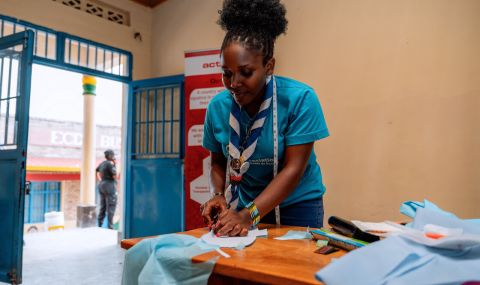
Belyne, a workshop leader at the Girls camp leads sessions on how to make reusable period pads. .

Equipping girls with reusable pad-making skills, confidence and power
Razia, 25, is a feminist leader and activist who attended Stepdown training workshops under ActionAid’s Global Platforms. Since then, she has led workshops on making reusable pads, women’s rights and family planning ensuring girls have the knowledge and tools to manage their periods with dignity.
Determined to reach as many girls as possible, Razia visits homes to speak with parents, approaches schools and churches, and requests time at community gatherings to talk about girls’ rights. She first learned how to make reusable pads herself through YouTube, investing in mobile data to follow step-by-step tutorials before training her peers, who now co-facilitate sessions with her.
To sustain the work, Razia encourages participants to form savings group to buy materials for pads and soap. Girls now make enough pads for themselves, and extras to sell.
Razia conducts several workshops on making reusable pads, women's rights and family planning at refugee settlements in Uganda.
Esther Mbabazi / ActionAid
Footnotes
- 1Starr et al., Epidemiology of menstrual-related absenteeism in 44 low- and middle-income countries, The Lancet Global Health, 2024.
- 2https://pmc.ncbi.nlm.nih.gov/articles/PMC11458041/
- 3https://www.un.org/unispal/document/silent-struggles-the-menstrual-hygiene-crisis-in-gaza-may-2025-unfpa-advocacy-brief/
Page updated 30 October 2026