Violence against women: the statistics around the world
Find out more about gender-based violence, and how it affects women and girls from the UK and across the world.
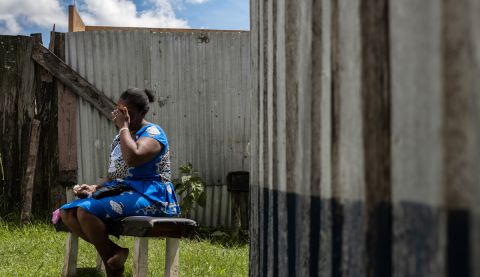
Julia, a survivor of domestic violence in Nakuru County, Kenya, rebuilt her life as a hairdresser and now supports other women through the SGBV Survivors Network. Photo: Rehema Baya / ActionAid
Violence against women and girls is a fundamental human rights violation, affecting around one in three women and girls around the world.1
From the UK, to around the world, women and girls face forms of violence and discrimination in every society, whether it’s domestic abuse, sexual violence, female genital mutilation or psychological violence.
But ActionAid is working to build a safer world, in which no woman or girl lives in fear of violence.
Below, we set out statistics showing the scale of the problem, and how violence affects women around the world.
Violence against women: the statistics
Research shows gender-based violence affects women and girls in every society around the world.
Nearly 50,000 women and girls were killed by an intimate partner or other family member in 2024. This represented 60% of the approximately 83,000 intentional killings of women and girls worldwide. On average, 137 women and girls were killed every day by someone in their own family, equivalent to one death every 10 minutes.2
Most of the violence women and girls face is at the hands of intimate partners and family members, and it begins at an early age. The latest WHO analysis shows that nearly one in four girls and young women (24%) aged 15-19 who have ever been in a relationship have experienced physical or sexual violence by an intimate partner before the age of 20, highlighting how early abuse can start.3
It is important to remember that violence against women and girls is often hidden and under-reported, making it difficult to measure its full extent. Many survivors never disclose their experiences due to fear, shame, stigma, or concerns about their safety. Globally, only 40% of women who experience violence seek help from any source, highlighting the significant barriers many women face in reporting abuse and accessing support.4
Less than 40% of women who experience violence seek help of any sort. In the majority of countries with available data on this issue, among women who do seek help, most look to family and friends. Very few look to formal institutions; less than 10% of those seeking help appealed to the police.5
Violence against women and girls in the UK
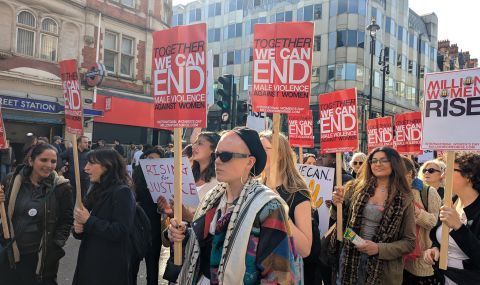
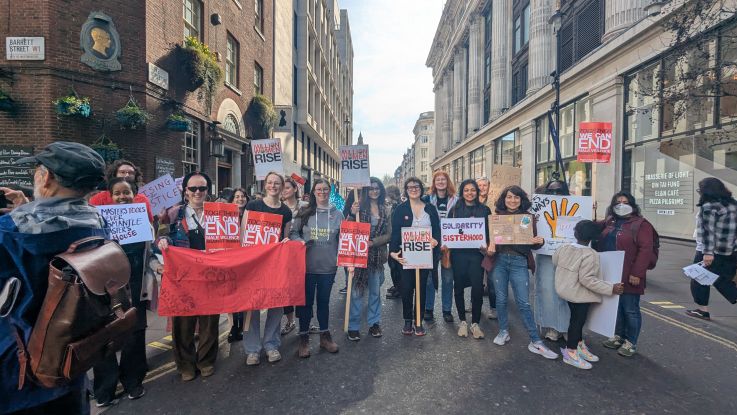
People marching with placards at the Million Women Rising event in London in March 2025 .
Across the UK, evidence suggests that violence against women and girls remains widespread and has increased in recent years.
In England and Wales, police-recorded violence against women and girls offences increased by 37% between 2018 and 2023, with more than one million offences recorded annually. The National Police Chiefs' Council has described the scale of violence against women and girls as a "national emergency", estimating that at least one in 12 women experiences violence each year.6
The latest ONS figures show that 13% of women aged 16 and over in England and Wales experienced at least one form of harassment in the previous 12 months, compared with 7% of men. Young women remain disproportionately affected, with around one in five people aged 16 to 24 experiencing harassment.7
An estimated 1.6 million women aged 16 and over experienced domestic abuse in England and Wales in the year ending March 2024, representing approximately 6.6% of women.8
The latest ONS estimates indicate that around 7.5 million women aged 18 and over (31.5%) experienced some form of abuse before the age of 18, including emotional, physical, sexual abuse or neglect.9
In the year ending March 2024, there were 108 domestic homicides in England and Wales, including 83 female victims. Of these, 66 victims were killed by a partner or ex-partner.10
Violence against women in other global north countries
In other global north countries, the prevalence of gender-based violence is similarly high.
- Across the European Union, one in three women (33%) have experienced physical violence, sexual violence or threats during adulthood, while one in six women (17%) have experienced sexual violence, including rape. Additionally, one in three women have experienced sexual harassment in the workplace, rising to two in five among younger women aged 18 to 29.11
The latest EU-wide survey also found that one in five women (20%) have experienced physical or sexual violence from a partner, relative or another household member during their lifetime.12
In the United States, more than one in three women (34%) have experienced physical violence, sexual violence and/or stalking by an intimate partner during their lifetime.13
Oklahoma remains among the states with the highest prevalence of intimate partner violence, with 41.6% of women experiencing intimate partner physical violence, sexual violence or stalking during their lifetime.14
Statistics from global majority countries
Violence against women is a global issue, but women in lower-income, conflict-affected and climate-vulnerable countries often face heightened risks due to intersecting social, economic and political inequalities.
Women and girls in global majority countries continue to experience high levels of gender-based violence, with prevalence rates often shaped by conflict, economic inequality, displacement, underfunded services and barriers to accessing support and justice.
Violence against women and girls in these countries cannot be understood in isolation from the wider social, economic and historical contexts in which it occurs. Colonial legacies, entrenched economic inequalities, conflict, displacement, debt burdens and austerity measures have often weakened public services and support systems, increasing women's vulnerability to violence and limiting access to protection and justice.
These structural factors interact with gender inequality in ways that can heighten risks and shape women's experiences of safety and support.
UN Women reports that women living in the world's low to middle income countries experience past-year intimate partner violence at rates of around 18%, compared with a global average of 11%, highlighting the heightened risks faced by women in some of the world's poorest communities.15
Incidents of sexual violence and harassment remain high in Egypt despite the criminalisation of both physical and verbal sexual harassment in 2014 and subsequent increases in penalties in 2020 and 2023.16The IDS review highlights growing concerns about online violence against women in Egypt, ranging from aggressive misogynistic abuse to threats of violence and rape directed at women content creators and activists.
South Africa continues to rank among the countries where women feel least safe. According to Gallup's latest global safety data, only 25% of women in South Africa said they felt safe walking alone at night, compared with a global average of 67% of women. 17
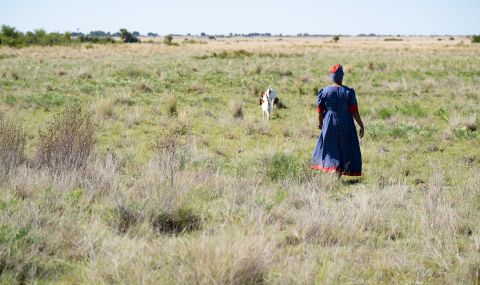
Mathlogonolo is a South African women's rights activist.
Lihlumelo Toyana / ActionAid
Behind the stats: why gender-based violence can be hard to measure
Behind every statistic are women and girls whose experiences may never be counted.
Violence is widely under-reported, with many survivors unable or unwilling to seek help because of fear, shame, social pressure, economic dependence, or concerns that they will not be believed.
This means the true scale of violence is likely far greater than official figures suggest. Globally, only around 40% of women who experience violence seek support, leaving the majority without access to formal help or justice.18
What ActionAid is doing to help build a safer world for women
Together with local communities and partners around the world, ActionAid is helping create a future where every woman and girl can live free from violence, fear and abuse.
ActionAid supports grassroots women's organisations, delivers lifesaving services for survivors, works with communities to challenge harmful attitudes, and campaigns for stronger laws and protections. By putting women at the centre of decision-making, we help drive lasting change that tackles the root causes of violence and inequality.
This includes
- creating safe spaces through girls' clubs in schools and communities
- helping women build sustainable livelihoods so they are not trapped by financial dependency
- working with whole communities, including men and boys, to challenge harmful attitudes that enable abuse
- connecting survivors with vital medical, legal and emotional support, provide emergency assistance during conflicts and disasters when the risk of gender-based violence often increases
- funding local women-led organisations that deliver frontline services and strengthen community safety.
- campaigning for stronger laws and protections against domestic abuse, child marriage, female genital mutilation (FGM) and sexual violence
- working alongside global feminist movements to advance women's rights and hold governments accountable for protecting them.
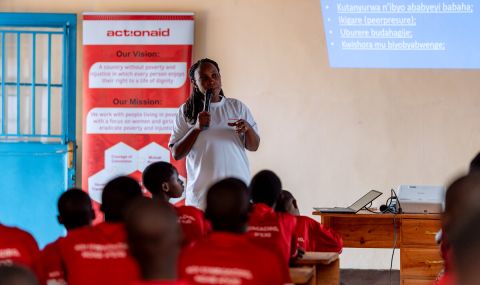
Olive is a lawyer and Acting Legal Advisor for Nyanza District, Rwanda. She was running workshops at the ActionAid girls camp on rights, justice and accessing local services.
Have you been affected by gender-based violence?
If you or anyone you know has experienced violence, there are services that can help. You don't have to report the assault to police if you don't want to.
These services may be able to help you:
24-hour National Domestic Violence Helpline - 0808 2000 247
A 24-hour national service for women experiencing domestic violence, as well as for their their family, friends, colleagues and others calling on their behalf.
Rape Crisis – 0808 802 9999
A free national helpline for women and girls who have experienced abuse, rape and all forms of sexual violence.
Galop, the LGBT+ anti-violence charity
Support for LGTB+ women, men and non-binary people who have experienced hate crime, sexual violence or domestic abuse. They also have a dedicated service for trans people.
The Survivors Trust
Support for all survivors of rape, sexual violence and childhood sexual abuse, no matter how long ago it happened.
Childline - 0800 1111
Free help and advice to anyone under the age of 19.
Footnotes
- 1
https://www.who.int/news-room/fact-sheets/detail/violence-against-women">https://www.who.int/news-room/fact-sheets/detail/violence-against-women
- 2
https://www.unwomen.org/en/digital-library/publications/2025/11/femicides-in-2024-global-estimates-of-intimate-partner-family-member-femicides">https://www.unwomen.org/en/digital-library/publications/2025/11/femicides-in-2024-global-estimates-of-intimate-partner-family-member-femicides
- 3
https://www.who.int/news/item/29-07-2024-adolescent-girls-face-alarming-rates-of-intimate-partner-violence/
- 4
https://www.unwomen.org/en/what-we-do/ending-violence-against-women
- 5https://www.unwomen.org/en/what-we-do/ending-violence-against-women/facts-and-figures
- 6
https://news.npcc.police.uk/releases/call-to-action-as-violence-against-women-and-girls-epidemic-deepens-1
- 7
https://www.ons.gov.uk/peoplepopulationandcommunity/crimeandjustice/bulletins/experiencesofharassmentinenglandandwales/december2023
- 8
https://www.ons.gov.uk/peoplepopulationandcommunity/crimeandjustice/bulletins/experiencesofharassmentinenglandandwales/december2023
- 9
https://www.ons.gov.uk/peoplepopulationandcommunity/crimeandjustice/bulletins/abuseduringchildhoodinenglandandwales/march2024
- 10
https://www.ons.gov.uk/peoplepopulationandcommunity/crimeandjustice/articles/homicideinenglandandwales/yearendingmarch2024
- 11
https://fra.europa.eu/en/content/eu-gender-based-violence-survey
- 12
https://fra.europa.eu/en/content/eu-gender-based-violence-survey
- 13
https://www.safestates.org/news/722022/CDC-Releases-the-National-Intimate-Partner-and-Sexual-violence-Survey.htm
- 14
https://oklahomawatch.org/2026/04/07/is-oklahoma-ranked-among-the-states-with-the-highest-rates-of-domestic-violence/
- 15
https://reliefweb.int/report/world/violence-against-women-prevalence-estimates-2023
- 16
https://www.ids.ac.uk/publications/rapid-scoping-review-2025-egypt/
- 17
https://www.gallup.com/analytics/356996/gallup-global-safety-research-center.aspx">https://www.gallup.com/analytics/356996/gallup-global-safety-research-center.aspx
- 18
https://www.unwomen.org/en/what-we-do/ending-violence-against-women