16 Days: honouring women who dare to resist
During the 16 Days of Activism, we honour the Mirabal sisters and women around the world who face threats, attacks, and even murder for speaking truth to power. Their courage demands our attention and action.
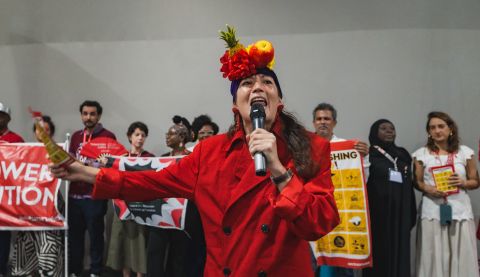
Climate activists at COP30, distinguishable by their red jackets and colourful 'just transition' bingo cards, called for climate talks to deliver on an outcome that puts people first. Photo: Agência Colabora / ActionAid
Whenever we talk about gender based violence our main focus is on domestic and sexual violence; however, the International Day for the Elimination of Violence Against Women was designated to remember and honour the three Mirabal sisters.
Patria, Minerva and María Teresa were assassinated in 1960 because of their political activism against the dictatorship of Rafael Trujillo in the Dominican Republic.
Many more women around the world have followed, and still do, in their steps.
Whether they fight against repressive regimes, against corruption, for women’s rights, for gender justice, to protect their land and territory, or for their dignity and their right to exist, they all face violence for daring to speak truth to power and to challenge the status quo.
As Rita Segato, an Argentine-Brazilian academic explains, violence is the last resort for the powerful to prove their power if other ways fail.1
Women from social movements become a threat
These women show others that it is possible to challenge those in power; alongside their movements, they become obstacles to extractive projects that could hurt their communities. Some of the women who were elected officials, suffered violence as they challenged, and blocked, corruption; or because they fight against policies that threaten the common good. In all cases they resist attempts to control and silence them, and they defy the status quo.2
While this is not a new phenomenon, it has been exacerbated by global politics marked by regression of rights of women and LGBTQIA+ people, the criminalisation of protest and dissent, and the promotion of an economic model based on the extraction and exploitation of nature and people.
It is also not a coincidence that this violence affects women and queer people who are among the most minoritised, such as Indigenous women and women from rural areas. Their historical and systematic exclusion from spaces of power and influence reinforces the impunity of the perpetrators.3
In particular, women who are human rights, environmental and land defenders have been at the receiving end of threats, accusations to discredit them, damage to their reputations and relationships within their families or communities, imprisonment, and physical violence, in some cases going as far as assassination.4
Unfortunately, this violence is often overlooked, as men are seen as the main political stakeholders by governments and companies; but also because the policies and services put in place to address violence against women are not fit to support them in this type of cases.
This is why it is important for us to speak about it, to name it, and to make it visible.
This is an effort to end the impunity of the perpetrators and to support the demands and efforts made by these women defenders, and to keep alive the legacy of, Patria, Minerva and María Teresa.
Footnotes
- 1
Rita Segato: Segato R. L. (2018). La guerra contra las mujeres. Prometeo. Segato R. L. (2018)
- 2
https://www.christianaid.org.uk/sites/default/files/2022-07/bolivia-women-politics-violence-case-study-j29334-aug2017.pdf
- 3
https://www.unwomen.org/es/articulos/articulo-explicativo/como-se-ven-amenazadas-las-defensoras-de-derechos-humanos-en-todo-el-mundo
- 4
https://assassination.globalinitiative.net/face/berta-caceres/