Young Urban Women's reflections on the Global Partnerships Conference 2026
This year's Global Partnerships Conference was centred around the theme of 'shifting power', focusing on sustainable and innovative finance, along with technology and AI.
Activists from Young Urban Women, an ActionAid programme that addresses young women’s economic rights and sexual and reproductive health and rights, have shared their reflections about what was (and wasn't) being achieved at the conference.
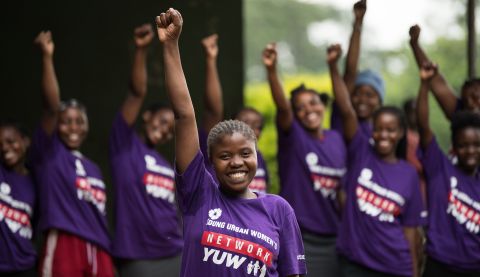
The Conference opened with an announcement by Foreign Secretary Yvette Cooper of a new international coalition to tackle violence against women and girls, alongside the refreshed UK government’s Women and Girls Strategy. At a time when gender rights are increasingly under attack around the globe, renewed political attention and investment is urgently needed.
Yet alongside these new commitments, ending violence against women and girls requires confronting the inequalities and injustices that drive it. Violence is sustained by social, political and economic systems that deny women and girls power, resources and decision-making. Addressing these structural drivers requires the UK government to genuinely shift power to the organisations and movements on the frontline who are already driving change, and to use its influence on the world stage to help dismantle the systems that enable harm in the first place.
While the language of localisation and partnership circulated throughout the Conference, there was notably limited participation from ‘Global South’ rights holders, Women’s Rights Organisations (WROs), and frontline communities whose lives are most directly shaped by development, climate and economic policies.
For the Young Urban Women in Malawi, this absence was not simply a question of representation. It raised deeper questions about whose knowledge is valued, whose experiences inform policy decisions, and whether development can truly be transformed without centring the voices of those living at the frontline of intersecting crises.
Reflecting on the Conference discussions through the lens of their lived realities and community organising experiences, Young Urban Women highlighted two issues that received insufficient attention: the interconnected impacts of climate change, debt, and austerity on women and girls, and the urgent need to move beyond rhetoric on power shifting towards meaningful inclusion and justice-centred development.
On climate justice
For many young women in Malawi, climate change is not an abstract environmental challenge, but a daily reality shaped by unequal economic systems and gendered power relations. As one young feminist organizer reflected following the Conference:
When droughts hit, women walk further for water. When schools close, girls are pulled out first. When floods come, women’s unpaid care burden becomes huge. That is not because women are naturally vulnerable. It is because of unequal land rights, limited access to Sexual and Reproductive Health services, exclusion from decision-making, and economic dependence."
Climate change does not affect everyone equally. Women and girls, particularly in low-income and rural communities, experience its impacts most acutely because existing inequalities place them at the centre of crisis response and survival. Yet climate policies often fail to address these structural drivers of vulnerability.
Experiences during Cyclone Freddy in 2023 demonstrated this reality clearly. In displacement camps across Mulanje, Malawi, women and girls faced heightened risks of sexual and gender-based violence, poor sanitation, disrupted health services, and increasing unpaid care responsibilities. Young women were often carrying the burden of survival for entire families while navigating insecurity and violence themselves.
As discussions on development financing continue, young women from the Global South must not be treated as beneficiaries of solutions designed elsewhere. They must be recognised as political actors whose lived experiences and expertise are essential to shaping effective climate responses.
Debt, austerity and the cost to women
A recurring concern raised by young women reflecting on the Global Partnerships Conference was the limited attention given to the lived consequences of debt and austerity. As another young urban woman observed:
Austerity is not gender neutral; it is a driver of gender-based violence."
When governments are required to reduce spending to meet debt obligations, the consequences are felt in communities through underfunded healthcare systems, shortages of teachers and nurses, reduced social protection programmes, weakened GBV response services, and the growing transfer of unpaid care responsibilities onto women.
Economic policy choices have real people behind them.
While austerity is often presented as fiscal discipline, young women highlighted how it can function as a form of structural violence. As public services are reduced, women are expected to absorb the impacts through unpaid labour, caregiving, and informal work. This limits economic independence, reduces opportunities, and increases vulnerability to poverty and violence.
Young Urban Women also questioned the Conference's emphasis on moving from a "donor" model to an "investor" model. While private investments may contribute to development in some sectors, investors primarily seek returns. Many of the services most critical to gender justice, including childcare, public healthcare, social protection, SRHR services, and GBV prevention, do not generate immediate financial returns but remain essential for human wellbeing.
Young women stressed that development cannot be measured solely through investment flows or market outcomes. It must be assessed through whether people are able to live with dignity, access quality public services, exercise their rights, and participate meaningfully in decisions that affect their lives.
For countries facing climate vulnerability and debt distress, addressing debt justice is therefore not separate from achieving gender equality. It is a necessary condition for it.
The future of decision making
Young women reflecting on the Conference called for development approaches that move beyond symbolic participation and instead place frontline communities, grassroots feminist organisations, and Global South movements at the centre of decision-making.
Their message was clear: climate justice requires debt justice. Gender equality requires strong public services. Development requires care. And meaningful partnerships require power to be shared, not simply discussed.
If the UK government wants to meet its commitments to women and girls rights, it must challenge the unjust systems that drive inequality and harm. The UK Government should:
Use its G20 Presidency in 2027 to champion urgent and radical reforms to the Common Framework to help countries in the 'Global South' fairly restructure their debts. This includes passing UK legislation to ensure private creditors take part in debt relief. It must also champion a UN Framework Convention on Sovereign Debt to transform the global debt architecture.
Champion the UN Tax Convention, which could help unlock billions for public services including healthcare, education and domestic abuse support. This should embed gender-responsive tax principles, ensuring tax systems reduce rather than entrench inequality, and enshrine the polluter pays principle, so that fossil fuel companies and other high-emitting industries bear the fiscal costs of the climate damage they cause.
Introduce a gender-responsive Business, Human Rights and Environment Act with strong provisions to address gendered corporate harms – ensuring that companies, and the banks which finance them, are held accountable for the disproportionate impacts their activities have on women and girls.
You can follow along with our other campaigns and see how you can get involved with changing the world with women and girls.