Building on momentum to end violence against women and girls
As the 16 Days of Activism begins, we reflect on a year of real progress, and on what it will take to turn that momentum into change that lasts.
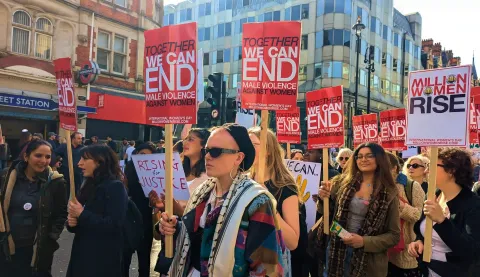
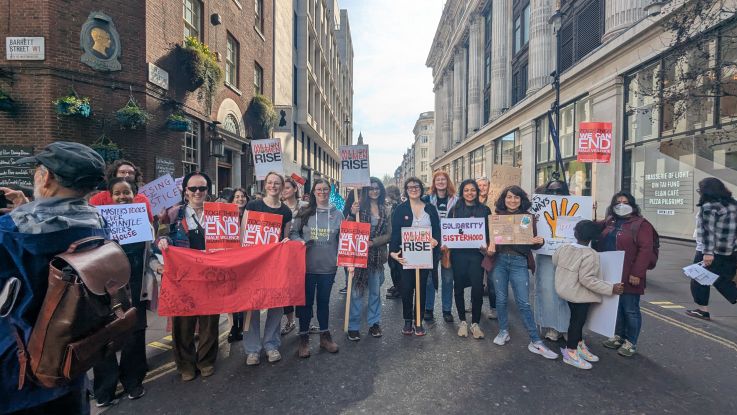
ActionAid marching for women's rights and to end gender-based violence. Photo: ActionAid
25th November is the International Day for the Elimination of Violence against Women. It marks the start of the 16 Days of Activism Against Gender-Based Violence, a campaign begun by feminist activists in 1991 that now mobilises people around the world each year until Human Rights Day on 10th December.1 This year's UN theme 'Ensure justice, protect survivors, end impunity', could hardly be more timely.2
The scale of the challenge remains stark. Nearly one in three women worldwide, an estimated 840 million, have experienced intimate partner or sexual violence and every ten minutes a woman or girl is killed by a partner or family member.3 We now know far more about what works to prevent violence; the challenge is to invest in it, at scale and for the long term.4
A year of significant progress
That is why this year's developments are so welcome. The UK, together with Australia, Brazil, Bosnia and Herzegovina, Jamaica, Morocco, South Africa and Spain, launched the International Coalition to End Violence against Women and Girls5. Spanning five continents, it brings together countries with distinct experience, from Spain's pioneering approach to domestic abuse to South Africa's long-standing commitment to ending gender-based violence and femicide. Members have committed to developing national pledges and action plans, and to learning from one another about what works.
The rights of women and girls have also been established as a standalone UK foreign policy priority, underpinned by a new International Strategic Framework on Women and Girls that recognises violence online and offline, in conflict and in peace6. This sits alongside an ambitious domestic mission to halve violence against women and girls within a decade.
There is also a commitment to placing survivors closer to the centre of this work, including through a planned Survivor Advisory Board. This reflects a principle the women's rights sector has long championed: solutions designed without survivors are rarely solutions that work. And in 2027, during the UK's G20 presidency, a global summit on violence against women and girls will bring together governments, civil society, business and survivors7. It is a valuable opportunity for governments to commit to investing in what works and to set out how they will reduce rates of violence.
What it will take
The question before all of us, governments, donors, civil society and the public alike, is how to make sure this moment becomes change that is meaningful, sustainable and able to withstand the wider rollback on women's and girls' rights. Guided by the women's rights and feminist organisations we work with, ActionAid is calling for seven things:
Tackling the structural roots of violence
Violence against women and girls is sustained by structural inequalities: unpaid care, unequal economic systems, insecure housing and work, and public services stretched beyond capacity. It also runs along a continuum, from violence in the home to the heightened risks women face in conflict and climate-related crises, and responses work best when they treat it as one agenda rather than separate ones. Where countries face severe debt burdens, the shelters, health services and social protection women rely on are often hit hardest.
Recognising the continuum of violence in a world of growing, and neglected crises.
Conflict, displacement and climate-related emergencies are increasing in number and intensity, and with them the risks women and girls face. Violence in crisis is not separate from violence at home; it sits on the same continuum, and policy responses are strongest when they treat it as one agenda rather than as distinct initiatives. Due to the increasing complexity and numbers of crises, there are also many women and girls in protracted and neglected crises whose rights have been deprioritised and forgotten. In almost all crisis contexts, women's rights organisations are the first and last to respond, often with no or minimal resources.8
Moving beyond inclusion towards intersectionality.
Black and racialised women, migrant and refugee women, disabled women, LGBTQI+ people and those living through conflict and displacement face disproportionate violence and the greatest barriers to protection. Inclusion asks who is missing from the room; intersectionality asks how overlapping systems of power create those barriers in the first place. That means designing policies and services with those most affected, not for them, and resourcing organisations led by and for these communities.
Standing firm against the rollback of rights.
Around the world, organised anti-rights movements are working to undo hard-won protections for women, girls and LGBTQI+ people. Here in the UK too, the language of ‘protecting women and girls’ is increasingly being co-opted to target migrants and racialised communities9. That framing does nothing to make women safer, and it puts migrant and racialised women at greater risk. Ending violence against women and girls means being a strong and consistent voice for the rights of all women, at home and internationally.
Building shared accountability and women's rights leadership
Commitments are only as strong as their implementation. The 2027 summit is an opportunity for every participating country to bring forward pledges with clear resources and timelines, and to agree a way of tracking progress in which women's rights organisations lead as partners, building a two-way exchange of knowledge and power between governments and movements.
Resourcing women's rights organisations and feminist movements
Women's rights organisations, particularly in the Global South, hold governments to account, run safe spaces, accompany survivors and transform social norms. Long-term, flexible and direct funding is what will allow today's commitments to outlast any single political cycle. From ActionAid partners' work to end FGM in Somaliland, Ethiopia, Senegal and Kenya, including The Girl Generation movement, that supports the Africa-led movement to end FGM/C, and supported Somaliland's National Anti-FGM Policy, to survivor-centred programming through the Women's Rights Programme in Nepal, Ethiopia and Kenya, this work is already changing lives.10
Making justice accessible to survivors
In keeping with this year's theme, justice must mean more than prosecution. For many survivors it also means being believed, being safe, accessing healthcare, sustaining a livelihood and, where appropriate, receiving reparations. Survivors, especially those least often heard, should help shape how justice is defined and delivered.
This is a hopeful moment. There is political will, a clear timeline and a growing coalition of countries committed to action. Women's rights organisations have sustained this struggle for decades, and they stand ready to lead what comes next.
Footnotes
- 1
https://www.actionaid.org.uk/blog/2025/12/06/16-days-honouring-women-who-dare-resist
- 2
UN Women, 16 Days of Activism 2026: Ensure justice, protect survivors, end impunity
- 3
WHO, Violence against women prevalence estimates 2023 (November 2025); UNODC and UN Women, Femicides in 2024 (November 2025)
- 4
WHO, Violence against women prevalence estimates 2023 (November 2025).
- 5
FCDO, May 2026: https://www.gov.uk/government/news/foreign-secretary-launches-new-international-coalition-to-end-violence-against-women-and-girls
- 6
FCDO, May 2026: https://www.gov.uk/government/publications/uk-international-strategic-framework-on-women-and-girls-2026
- 7
Foreign Secretary's speech, 20 May 2026: https://www.gov.uk/government/speeches/foreign-secretarys-speech-on-tackling-violence-against-women-and-girls-at-the-global-partnerships-conference-20-may-2026
- 8
Policy Brief: Addressing Women’s Protection Challenges in Liben and Ambassel Woredas, Ethiopia https://ethiopia.actionaid.org/sites/ethiopia/files/publications/AA-ProtectionResearch-English.pdf
- 9
Challenging the Far Right Weaponisation of Ending Violence Against Women and Girls: A Guide for Politicians and Third Sector Leaders, Women's Resource & Development Agency, 2025
- 10
Press-Release-A-Historic-Breakthrough-31st-October-2024-1.pdf