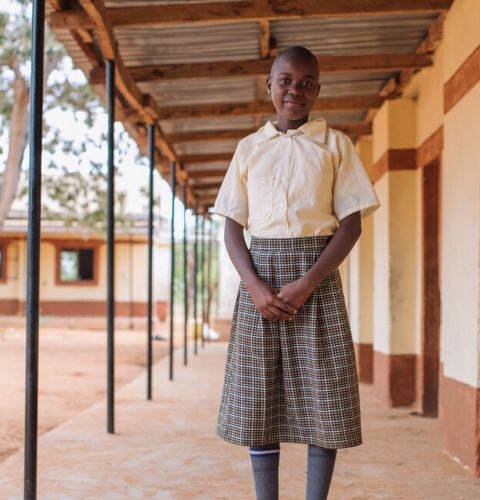
The education of girls has a transformative effect on lives and communities. Find out about the barriers girls face going to school, the benefits of girls' education and what ActionAid is doing to make sure every girl gets the start in life that she deserves.
How do we make sure girls stay in school?
ActionAid works with parents, teachers, children, civil society organisations and local authorities to make sure children have essentials like desks, books, food, drinking water and toilets at school.
We ensure that girls’ specific needs around access to menstrual products and advice on sexual reproductive health are met, so that they are able to go to school and stay there.
And we support Girls’ Clubs in schools, and in community spaces for girls not currently in school. These clubs offer a safe space for girls to learn about their rights, discuss issues and share experiences. In clubs girls also build their leadership skills so they can speak out in school, at home and in the community with confidence.
Supported by ActionAid, girls are leading their own positive change and challenging the harmful practices that impact girls, like child marriage and female genital mutilation (FGM).
What difference does it make when women and girls are educated?
All girls have the right to a quality education, but around the world nine million girls of primary school age will never set foot in a classroom, compared to about three million boys.4 The benefits of an education, both to girls and their communities, are extensive. This is why charities like ActionAid are so vital.
- Better-educated women tend to earn more, have better jobs, live healthier lives and invest their earnings into their families. Every additional year of school a woman attends increases her wages by an average of 12 percent.5
- Increasing girls’ education reduces infant and maternal mortality. Educated mothers have fewer pregnancies, are less likely to give birth as teenagers, and are better able to access the maternal healthcare they need.
- Increasing girls’ education reduces child marriage. Across 18 of the 20 countries with the highest prevalence of child marriage, girls with no education are up to six times more likely to marry as children than girls with a secondary education.
- Education helps give women the skills they need to take on leadership roles, including political positions. In those roles, they are much more likely to advocate for policies that benefit family and community life, like improved education and social services.6
Together, all of these factors help women to lift themselves, their families and entire communities out of poverty.7
Footnotes
- 1https://news.un.org/en/story/2019/09/1046272
- 2https://www.unicef.org/education/girls-education
- 3https://www.unicef.org/education/girls-education
- 5https://documents1.worldbank.org/curated/en/830831468147839247/pdf/WPS7020.pdf
- 6https://www.malala.org/brookings-report/the-worlds-best-investment-girls-education
- 7https://www.worldbank.org/en/topic/girlseducation
Page updated 4 February 2026