Women’s economic justice
What is women's economic justice?
Women’s economic justice is the full realisation of women’s rights to participate in, benefit from, and shape economic systems and decisions—free from violence, exploitation, and discrimination.
It goes beyond individual economic empowerment to focus on changing structural inequality, including patriarchy, capitalism, colonialism, and neoliberalism.
Why do we need women's economic justice?
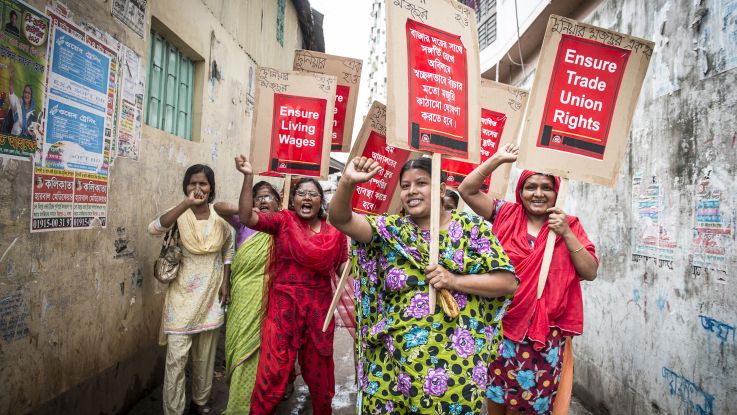
For decades, women around the world have been confronting a global economic system that is set against them, with barriers to decent and dignified work, few opportunities and protections of their labour rights, poor access to quality and affordable healthcare, and education, unstable incomes, and emotional stress.
These struggles are often even greater for Black, Brown, migrant and Indigenous women—both in the Global South and in richer countries like those in Europe and North America.
Governments around the world have responded to economic problems with budget cuts, especially in healthcare, childcare, and decent work programmes, primarily in response to coercive economic advice from International Financial Institutions. These cuts hit women the hardest, making it even more difficult for them to support themselves and their families.
In many ways, the global economy depends on labour from women of colour, especially from the Global South — continuing old patterns of exploitation that go back to colonial times. Their labour is often unpaid, unrecognised and undervalued.
True women's economic justice requires a decolonial, feminist and just economic system, which we call feminist wellbeing economies (FWE). Find out what we mean by feminist wellbeing economies below.
While empowering women individually is essential and a vital step toward gender equality, it is not sufficient on its own. It can place the burden on individuals, ignores structural inequalities, and often fails to deliver lasting change.
As long as the underlying systems and institutional structures that enable the economic exploitation of women remain intact, progress will be limited and challenging.
To create meaningful and lasting change, we need to address the root causes of economic injustice — including unequal access to resources, discriminatory labour practices, entrenched social norms that devalue women's work and by tackling the interconnected issues that shape women’s lives.
Only by dismantling these systemic barriers can we ensure that economic empowerment is both transformative and sustainable.
ActionAid embraces a human rights-based and systems change approach to women's economic justice.
What are feminist wellbeing economies?
A feminist wellbeing economy (FWE) is an economic system that puts people and the planet first instead of growth and profits.
ActionAid's work on feminist economic justice challenges the idea that there is only one way to run an economy.
We support alternative approaches developed by feminist economists, activists, women’s rights organisations (WROs), and social movements— that centre care, sustainability, dignity, and collective wellbeing rather than profit and growth at all cost.
The FWE is about more than just getting women better jobs. It means rethinking how the whole global economy works. It means challenging harmful practices like tax evasion, environmental destruction, and the exploitation of natural resources. It also means using new ways to measure progress — like wellbeing and community health, not just money.4
Achieving economic justice for women requires deep, structural change. It means listening to women’s voices, valuing their work (paid and unpaid), and making sure economic systems work for everyone—not just the wealthy few.
As the world continues to rebuild amidst multiple crises — including conflict, public health, and climate — we believe this is a crucial moment to reimagine economies that are just, sustainable and feminist.
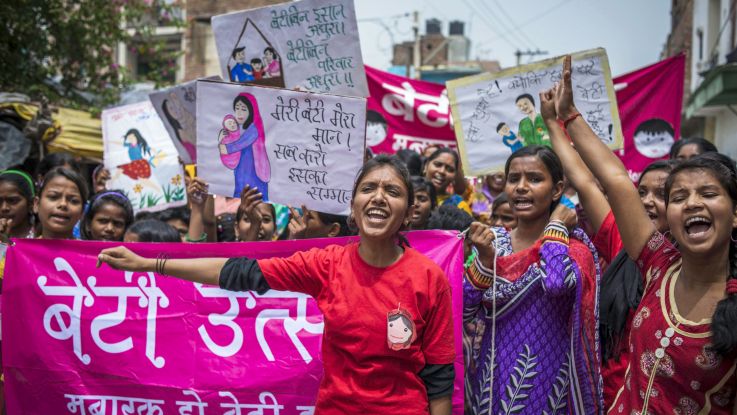
Our work supports the leadership of women and girls — especially those from the most marginalised communities — to demand accountability, claim their rights, and collectively drive structural change.
ActionAid's commitment to women's economic justice
We are committed to transforming the global economic system so that it works for women and girls in all their diversity.
For too long, the existing economic system has reinforced gender inequality, exploited women's labour, and deepened power imbalances — both within countries and between the Global North and Global South.
At ActionAid UK, we support women's rights organisations in:
- Valuing all forms of women’s work, especially unpaid and underpaid care work.
- Ensuring access to decent work, living wages, and social protection.
- Securing public services — like health, education, and childcare —that are gender-responsive and adequately funded.
- Redistributing power and resources, including across the Global North and South.
- Challenging and dismantling the economic, social and political systems that maintain women's exclusion and exploitation.

Zuwairiya (right) navigates the daily hardships of raising her children in Angwagwagwalada, illustrating the urgent need for economic justice and community investment.
Ugochukwu Onuoha/ActionAid
The everyday impacts of the IMF policies on austerity in Nigeria
Zuwairiya, a mother of seven in Angwagwagwalada, near Nigeria’s federal capital, faces the harsh realities of austerity and government budget cuts. With no local schools, children trek over an hour to attend classes, or pay N1000 for motorcycle transport, an impossible expense for many families.
The IMF influences countries’ budgets through its loans and policy advice. Often, these come with conditions requiring governments to reduce public spending, cut subsidies, or limit investment in essential services. In communities like Angwagwagwalada, this translates into school closures, poor infrastructure, limited healthcare access, and increased burdens on women, perpetuating cycles of poverty and inequality.
Unsafe roads and lack of healthcare have led to tragic losses, including pregnant women dying en route to clinics and children succumbing to cholera from contaminated water.
Despite these challenges, Zuwairiya continues to care for her children and advocate for change. ActionAid highlights stories like hers to show the human cost of IMF-backed austerity, pressing for investments in education, health, and infrastructure rather than debt repayment.

Building power through the Young Urban Women Programme
Lerato, a young mother and member of the Young Urban Women (YUW) Blantyre club, is a passionate advocate for women’s rights in her region.
The Young Urban Women (YUW) programme places a commitment to building the active agency of young women living in poverty. This includes addressing young women’s access to decent work and sexual and reproductive services through empowerment, campaigning and solidarity.
From challenging gendered stereotypes to demanding better funding for health services and access to education, Lerato is calling for investment in healthcare, and equality in the classroom. Her advocacy is shaping a future where women lead, speak, and thrive — economically, socially, and politically.
The most important thing I've learned is for a woman to be independent, not to rely on someone else.”
Young Urban Women (YUW) Lerato a member of YUW Blantyre.
Thoko Chikondi / ActionAid

Through ActionAid-supported training and her work with the Anyelir Berkarya women’s group, Lilis has rebuilt her confidence and grown into a community leader and entrepreneur..
Bima Artoko/ActionAid
From financial insecurity to economic independence
Lilis is a single mother raising three sons in Sumberjaya Village. Married young, she endured years of physical and emotional abuse, isolation and betrayal. Her life changed abruptly when her husband died in an accident, leaving her with no financial security and a seven-month-old baby. Overwhelmed and grieving, Lilis relied heavily on her family to survive.
Her turning point came when she joined a women’s empowerment programme supported by ActionAid and implemented with local partners Pattiro Banten and YAPPIKA-ActionAid. Through training, mentoring and participation in the Anyelir Berkarya women’s group, Lilis rebuilt her confidence and leadership skills.
Today, she facilitates women’s meetings, runs a small beachside shop selling locally made snacks, and is learning to market products online. “Nothing is impossible,” she says proudly.
I never imagined I could be like I am now, having my own business, being part of the women's community and being a role model for children. Nothing is impossible. Their future is my aspiration and I am ready to make the most of what I have for them."

Supporting women workers to rebuild after Rana Plaza
Mousumi is a survivor of the Rana Plaza collapse in Bangladesh, a tragedy that changed her life. A garment worker on the sixth floor, she was trapped under rubble for three terrifying hours after being forced to work despite visible cracks in the building.
She survived with serious injuries and ongoing physical and psychological trauma. Through ActionAid’s Workers Café, Mousumi received counselling, medical care, and training, and a sewing machine to start a small business.
This support has given Mousumi renewed confidence, dignity and hope for a safer future for women workers.
ActionAid Bangladesh's 'Workers Cafe' has helped us in various ways including providing training, giving counseling as well as assisting with financial support. Recently I got a sewing machine from there and I am hoping to start a small business using it. These types of support gave us the courage to stand up again and be aware of workplace safety and security."
Mousumi Begum is a survivor of the Rana Plaza collapse in Bangladesh, a tragedy that changed her life forever.
S. H. M. Mushfiqul Alam/ActionAid
Footnotes
- 1
The Human Cost of Public Cuts in Africa. https://www.actionaid.org/publications/2025/human-cost-public-cuts-africa
- 2
The Human Cost of Public Cuts in Africa. https://www.actionaid.org/publications/2025/human-cost-public-cuts-africa
- 3
UN Women ‘Progress of the world’s women 2015-2016, transforming economies, realising rights.
- 4
https://www.actionaid.org.uk/publications/feminist-wellbeing-economies
Page updated 28 August 2026