Mozambique
Why we work in Mozambique
ActionAid began work in Mozambique in 1987, initially providing emergency relief to people fleeing the civil war which lasted for 16 years and left millions dead or displaced.
Today our key areas of work include education, women’s rights and ending hunger.
Despite being one of the world’s fastest emerging economies, more than half of Mozambique’s population live below the poverty line. Although the country’s rich natural resources have attracted recent foreign investment, the benefits have failed to reach the majority of people.
Flooding, drought and erratic rainfall in Mozambique make farming a challenge for families already living below the poverty line. Most women do not own the land they farm, despite the fact that 90% of farmers here are women.
Women’s rights in Mozambique
Women are often treated unequally in Mozambique.
Nearly half of all women are forced to marry before their 18th birthday. It is also common for women to face traditional practices such as “Kutxinga”, or widow purification, in which they are forced to marry their late husband’s younger brothers.
Although Mozambique has achieved over 90% enrolment in primary education, (compared to just 56% in 1995), drop-out rates are still high, and it is mostly girls who are missing out on a full education.
Nearly half of women are illiterate, and many are unaware of their rights to basic services like healthcare.
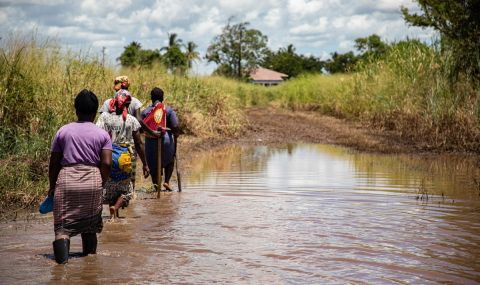
Smallholder farmers walking through flooded paths after floods in Buzi, Mozambique .
What we do in Mozambique
Through our work supporting farming associations, ActionAid helps thousands of women to access and control the land they work on, and increase the amount of food they produce.
We train women in sustainable farming methods, enabling them to plant diverse and resilient crops that will grow throughout the year and boost their income.
We also support families who have been affected by floods by providing emergency food supplies, shelter, and seeds to replant crops.
Supporting women’s rights and ending violence
ActionAid works with women’s groups, police officers, teachers and students to raise awareness of the dangers of harmful traditional practices, and to reinforce the protection of women and girls in their everyday lives – at home, in school, at work on public transport and in market places.
We support thousands of women and girls, offering workshops on how to identify and report incidences of violence and to follow-up with local courts and tribunals.
To improve education opportunities for women, we support groups where they can learn to read and write. These groups also play a fundamental role in raising adults’ awareness of the barriers to children getting an education, and come up with ways in which children – particularly girls - could be encouraged to return to school.
We also train and support school councils which bring together children, parents, teachers and the wider community to tackle issues like drop-out rates and making schools safe for girls.
Amid the heightened risk of gender-based violence, we've been working with a team of community activists and implementing a referral system to protect women against violence and report any cases.
Supporting people affected by disasters
Southern Africa food crisis 2020
Mozambique faced a severe food crises in 2020, related to two devastating cyclones which struck in 2019, and the worst drought the region had faced in 35 years.
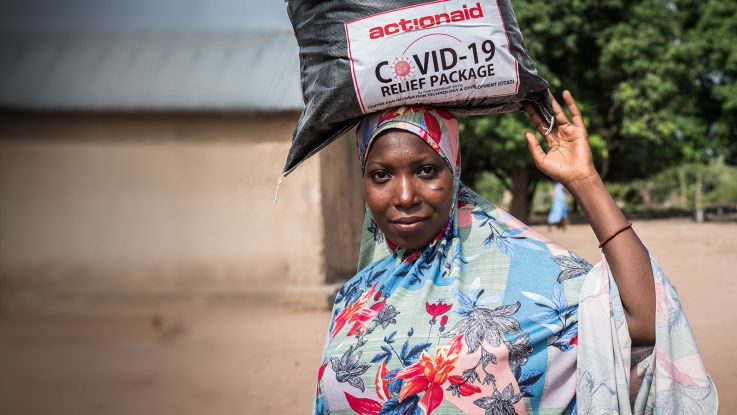
ActionAid distributed life-saving items like food and water purification tablets, plus critical items for longer term health like menstrual products and hygiene kits.
Cyclone Idai 2019
In March 2019 we responded to Cyclone Idai, a devastating cyclone that affected Mozambique, Malawi and Zimbabwe.
Possibly the worst weather-related disaster to ever hit the southern hemisphere, the cyclone killed at least 1,000 people and left 400,000 without a home.
Mozambique was the worst-affected country in the region - 1.5 million people were affected.
ActionAid’s initial response included distributing food, blankets, water sterilising tablets, shelter, clothes and mosquito nets in the affected countries. In Mozambique, our response included:
- the distribution of sanitary kits for women and girls
- the distribution of school books, so children could continue to learn
- establishing women-friendly spaces to help prevent violence against women and girls, and provide psychological support to those affected.
In the long-term, our work includes helping communities to rebuild their livelihoods, by training women in farming and distributing agricultural tools.

Breaking barriers: Zamia’s path into plumbing in Mozambique
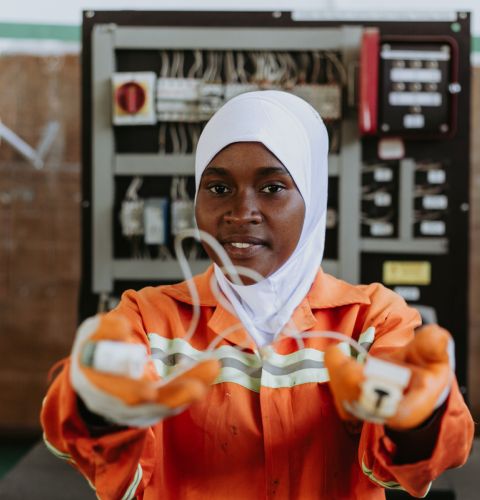
DZamia is a plumber living in Nampula, the capital of Nampula Province in northern Mozambique. Curious about the trade through her brother-in-law, she enrolled in a plumbing course run by ActionAid partner IFPELAC after hearing about it from a friend. After completing the training, Zamia and three other women plumbers now take on small jobs in their neighbourhood, fixing taps and water meters in people’s homes.
She completes around four to five jobs each month, earning money to buy clothes and materials for her work. As her experience grows, Zamia hopes to secure employment with a plumbing company. During a recent cyclone, she also supported a displaced friend and her family, hosting them in her home for three months.
I tell women that the most important thing is to build friendships with people. You have to have friendships. If you don’t have friendships with people nobody will help you."
Zamia, a trained plumber in Nampula, is building independence through skilled work while supporting her community in times of crisis.
Dilayla Romeo/ActionAid
Footnotes
- 1 https://www.unicef.org/media/137596/file/Tech-based-Interventions-Adress-Harmful-Practices-2023-Mozambique-v2.pdf
- 2 https://databankfiles.worldbank.org/public/ddpext_download/poverty/987B9C90-CB9F-4D93-AE8C-750588BF00QA/SM2021/Global_POVEQ_MOZ.pdf
- 3 https://www.unicef.org/mozambique/media/5731/file/UNICEF%20Mozambique%20Advocacy%20Brochure%202022%202026.pdf
Page updated 24 September 2026