Sexual and reproductive health and rights of women and girls
Abortion and reproductive rights
Around the world, many countries restrict access to safe, legal, affordable abortion, putting thousands of women's lives at risk. Recent studies estimate that 8–18% of maternal deaths worldwide are due to unsafe abortion, and the number of abortion-related deaths in 2014 ranged from 22,500 to 44,000.1
Most of these deaths occur in developing countries, with the highest number in Africa. Allowing women and girls access to information about their sexual and reproductive health and rights, including modern contraception and safe abortion, would prevent unplanned pregancies, STIs, and would save the lives of some of the poorest, most marginalised women and girls.
It would also have a positive impact on gender equality more broadly, including women’s economic rights. While there continues to be strong opposition to sexual and reproductive health and rights in many parts of the world, this poses a threat to women’s health and lives.
Domestic violence and sexual and reproductive health and rights
One in three women globally will face violence in their lifetime. Violence against women and girls (VAWG) is intrinsically linked to the denial of access to sexual and reproductive health and rights – meaning that many women do not have control over their body and their fertility.
Domestic violence is the most common form of violence against women. It manifests itself in physical, sexual or emotional abuse as well as controlling behaviours by a current or former partner. This has a profound affect on women's abilities to prevent unwanted pregnancies and puts them at increased risk of sexually transmitted infections.
Attempting to address sexual and reproductive health and rights without addressing violence against women will deny millions of women the right to full control of their bodies and lives. The links between them and the gender inequality at their root must be recognised. If it is not, progress on sexual and reproductive health and rights – including family planning - will be slow, unsustainable and will leave women and girls who experience violence behind.

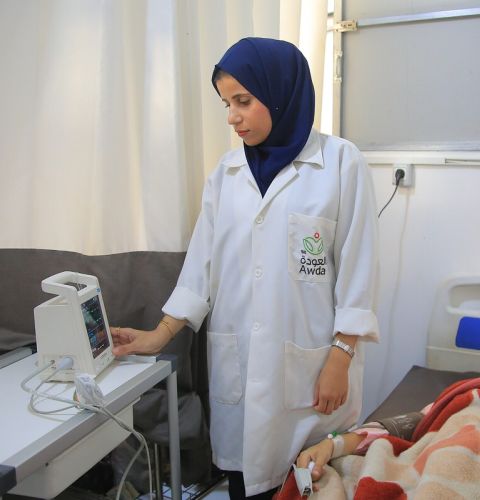
Farah is a nurse at Al Awda hospital in Gaza
Islam Abu Aisha/ActionAid
Meeting maternal and reproductive health needs during displacement
In September 2025, large-scale evacuations from Gaza City led to a sharp rise in displaced populations in the central and southern areas. Al-Awda Hospital, the only facility in the middle of Gaza,providing delivery and gynecological surgery services, faced unprecedented pressure. The demand for maternal and reproductive health care surged, particularly for pregnant and lactating women, female-headed households, and displaced families.
Through the DPRF project, ActionAid ensured that vulnerable groups, including persons with disabilities, received care and referrals without discrimination. Hospital assessments and social worker referrals helped identify those most in need, guaranteeing equitable access to essential health services.
“The rapid influx of displaced families meant that every day, more women needed delivery and reproductive care than we could have anticipated,” explained a hospital staff member.
Through careful prioritisation and referrals, we ensured that pregnant women and those with critical needs were never turned away.”
By centring women and girls in its response, the project not only delivered vital health services but also strengthened the resilience of displaced populations in Gaza during a period of acute crisis.
FGM and sexual/reproductive rights
Female genital mutilation (FGM) is the partial or full cutting of a girl’s clitoris and labia, for non-medical reasons. It is a form of violence against women and girls because it is used to control a survivor's body.
The families of girls undergoing FGM can be unaware of the devastating risks of this practice for girls' health: FGM can cause severe bleeding, infection, infertility and even death. Between 100 and 140 million women and girls have undergone FGM worldwide.1

Christine's story: how FGM puts girls' lives at risk
Christine underwent FGM at age 12 and bled severely. A year later she was married, despite her protests to her family. "I was young," she added. "I wanted to stay a little longer, to be older."
Christine became pregnant, but when the time came to deliver her baby, scarring from FGM and her age meant that she wasn't able to give birth naturally. She had to be rushed to hospital to have a caesarian section. "The doctors and nurses said that my child was big and I was small," said Christine.
She is against FGM happening to other girls in her community in West Pokot, Kenya, because of the risks it poses to their health during pregnancy and to their babies.
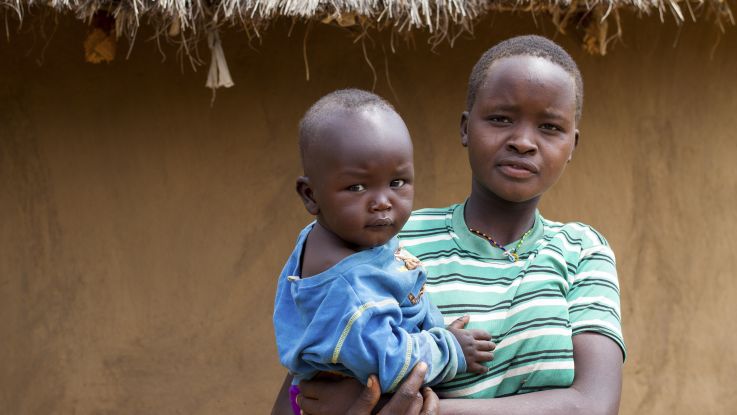
Christine, from Kenya, underwent FGM at the age of 12. She had to have a caesarian section to safely deliver her baby boy Amos.
Ashley Hamer /ActionAid
Child marriage and sexual/reproductive rights
Child marriage is defined as a formal marriage or informal union before the age of 18. Girls are disproportionately more likely than boys to be married before this age.
Early and forced child marriage puts girls at a higher risk of sexual, physical and psychological violence throughout their lives.2 It is a violation of girls' rights as, very often, marriage happens against the girl's will and she is physically and emotionally unprepared for sexual activity, pregnancy and child birth.
Child brides often marry much older men and have limited power to choose whether they have sex and when to use protection and family planning methods. This leaves them vulnerable to forced sex and sexually transmitted infections (STIs) including HIV, and unplanned pregnancies. Nearly 12 million girls worldwide have been married before the age of 18 - many of them against their will.3
Footnotes
- 1Prevention of violence against women and girls: what does the evidence say?, The Lancet: http://www.thelancet.com/journals/lancet/article/PIIS0140-6736(14)61703-7/abstract
- 2Girls Not Brides: 'Why is child marriage a form of violence against women and girls?: http://www.girlsnotbrides.org/why-is-child-marriage-a-form-of-violence-against-women-and-girls/
- 3Girls Not Brides: http://www.girlsnotbrides.org/about-child-marriage/
Page updated 11 February 2026