Climate change and flooding
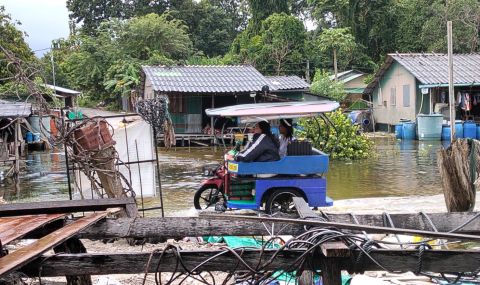
More than 2 million people were impacted by flooding in Thailand's southern provinces in 2025 .
What are floods?
Floods are defined as sudden onset events where normally dry land is inundated with an overflow of accumulated water that it is unable to absorb.3
There are several types of floods with differing speeds, such as flash floods caused by heavy rain, river floods which are seasonal, and coastal floods associated with cyclones and tsunamis.
What causes flooding?
The frequency and intensity of floods that we are witnessing globally have numerous causes.
For example, degradation of soils and the ecosystem due to unsustainable development makes it increasingly difficult for lands to absorb the waters from heavy rains.
The combination of erratic and increasingly intense rainfall – which is increasingly difficult to plan for – with poor ongoing land management and degradation, makes certain regions and communities particularly vulnerable to flooding.4
Communities based in coastal regions are particularly at risk because they also face a threat from sea-level rise and storm surges. All of this is exacerbated by little or poor flood planning and management5.
How does flooding affect women and girls?
Climate change disproportionately affects women and girls because it exacerbates inequalities that women and girls already face.
Women and girls are more likely to live in poverty than men and face more discrimination and violence, which can heighten during crises or periods of instability.
Women and girls are particularly vulnerable to a climate-change-related event like flooding in the following ways:
- When disasters like flooding strike, women and children are more likely to die from drowning than men due to lack of resources, communication and, in some instances, being less likely to be able to swim than men.6 Up to four times as many women as men died in the tsunami of 2004. In Indonesia, an average of 77% of the fatalities were women.7
- Flooding can result in displacement and migration. Women and girls may have to leave their homes and move into displacement camps while men move away to look for work. Women also experience difficulty living in camps as they have specific needs around managing periods without access to toilets and running water.8
- Violence against women and girls (VAWG), including domestic violence, tends to increase during disasters as existing social structures are weakened or destroyed. Women also tend to take on new roles in the aftermath of a crisis, like having to fetch water over longer distances, putting them at additional risk.9.
- The risk of early and forced marriages is high in the aftermath of climate-change-related disasters, as families face income and livelihood stresses and further poverty.
- Girls are forced to drop out of school as unpaid care and domestic responsibilities at home may increase.
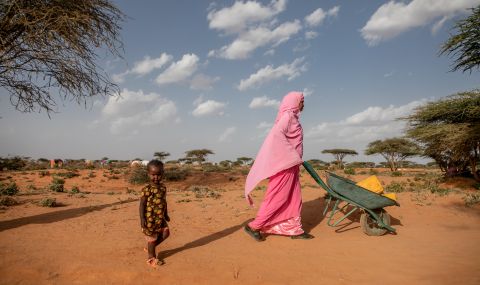
Hibaq Mohamed (age 38 yrs) in Somalia goes to the nearest well point to collect water in the IDP camp where she lives with her 8 children.
Why doesn't drought end when it rains heavily?
It is common for areas that experience drought to also be susceptible to intense rains and flooding.
For example, Somalia and parts of Somaliland can experience heavy rain, but they have also experienced more periodic droughts. These droughts have occurred due to shorter rainy seasons and sporadic and unpredictable rainfall.
Recurrent droughts dry out soils and land. But intense rain over dry land does not necessarily mean less drought.
Heavy, intense rainfall tends to run off the surface of soil, washing away any nutrients on the top instead of gently soaking it. Cracked, arid land caused by drought is also unable to soak up the moisture fast enough.
Even if a heavy rain breaks a drought it is usually for short periods of time, and a return to irregular rain patterns means water in the soil is used up or evaporates quickly again. To grow crops and sustain livestock, farmers and communities need a steady, regular pattern of rainfall that gently soaks the land.
The unpredictability of the weather makes it more and more difficult for vulnerable communities to plan ahead and adapt to changes in the weather.

Women led several community support initiatives following the 2024 floods
ActionAid
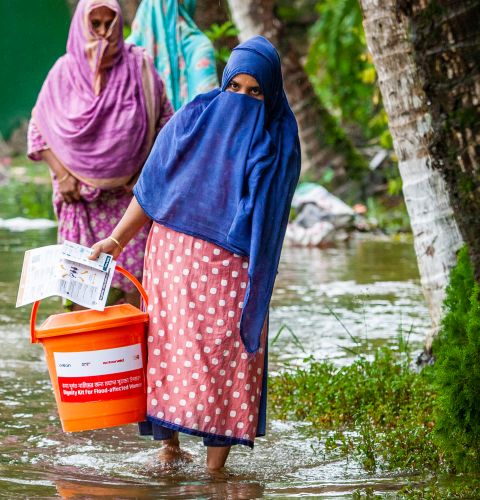
Women supporting their communities following flooding
As devastating floods swept through Bangladesh, the founder and president of Changemakers for Rights & Development (CRD), Aklima knew that action was urgently needed.
Supported by ActionAid, she quickly initiated a nationwide social media campaign to raise funds, reaching out to people across the country for help.
The response was overwhelming, as donations poured in from those eager to support her cause.
Aklima wasn’t just collecting money—she was building a movement of compassion, showing that even in times of despair, unity and solidarity could make a difference. Leading a dedicated team of 10 volunteers, she set out to provide immediate relief to the flood-affected people in shelter homes across the region.
What does ActionAid do when floods strike communities?
Women and girls are not just survivors of climate-related crises; they are forging ahead and leading change. ActionAid is working closely with them to give them a chance of a climate-positive future.
- With local authorities and other partners, ActionAid trains women and girls in disaster risk reduction by helping them to spot early warning signs and facilitating communication with their communities to ensure efficient and timely evacuations and support.
- ActionAid trains people to develop more climate-resilient agricultural techniques. In countries where flooding is common, ActionAid works with women to develop modes of agriculture that are more adaptable to or can withstand flooding's effects. For example, planting adapted crops that are tolerant of wet conditions such as saline-resistant rice in Bangladesh.
- ActionAid also works with women to reduce the impact of floods. For example, we help women in Cambodia plant mangroves to provide flood protection by reducing the force of oncoming waves and storm surges.
- ActionAid works with women to develop alternative livelihoods and income sources during and after times of crisis or long-term changes.
- During immediate emergencies, ActionAid provides relief by cash transfers or food, water purification tablets, hygiene kits, building shelters and toilets and supporting women at risk of violence.
Footnotes
- 1https://www.bbc.co.uk/news/science-environment-50407508
- 2https://www.independent.co.uk/environment/climate-change-sea-levels-melt-ice-rise-threat-antarctica-a8111351.html
- 3http://un-spider.org/risks-and-disasters/natural-hazards/flood
- 4https://public.wmo.int/en/our-mandate/water/floods
- 5https://www.carbonbrief.org/how-much-flooding-is-in-the-uks-future-a-look-at-the-ipcc-repor
- 6https://deeply.thenewhumanitarian.org/womenandgirls/articles/2016/07/12/why-teaching-women-to-swim-helps-children-too
- 7https://www.theguardian.com/society/2005/mar/26/internationalaidanddevelopment.indianoceantsunamidecember2004
- 8https://www.acclimatise.uk.com/2017/09/19/floods-spearhead-disaster-related-displacement-worldwide/
- 9https://assets.publishing.service.gov.uk/government/uploads/system/uploads/attachment_data/file/271932/VAWG-humanitarian-emergencies.pdf
Page updated 9 February 2026