Climate and sustainable fishing
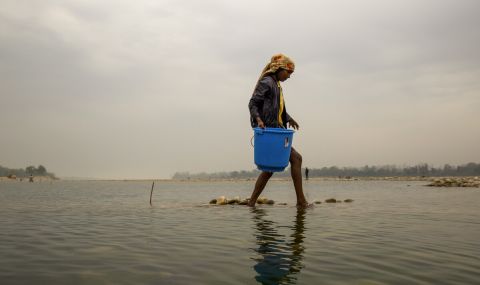
Fishing in a traditional way in the Karnali River in Nepal .
The impact of industrial fishing
High global demand for fish has led to poor practices in fishing that are destroying marine life and habitats.
- Industrial fishing that uses large trawlers and cutting-edge technology has made fishing more efficient to meet the demands of increased consumption. This has increased overfishing - catching fish faster than fish can reproduce or replenish, reducing the number of fish species in our oceans.
- As fish are unable to reproduce fast enough to match the growing demand, ships sail further, sometimes illegally into other territories causing conflict.
- Loss of marine life locally affects the food security and livelihoods of poorer, traditional fisherfolk especially in Africa, Latin America, and south and north-east Asia. More than 3 billion people in the world depend on marine life for their livelihoods4.
- Industrial fishing also uses practices that adversely affect bio-marine life. Destructive methods like longline fishing and bottom trawling where a large net is dragged across the ocean floor to capture all kinds of fish also destroy reefs, seabeds and other plants and organisms.
- Bad practices such as these also increase the number of by-catches - sea life like turtles and seabirds that are not needed and are usually considered collateral in large-scale fishing.
- Aquafarms breed fish often in confined spaces and use of antibiotics and pesticides can contaminate surrounding water and land and affect wild fish populations. It is also contributing to a loss of natural mangroves.
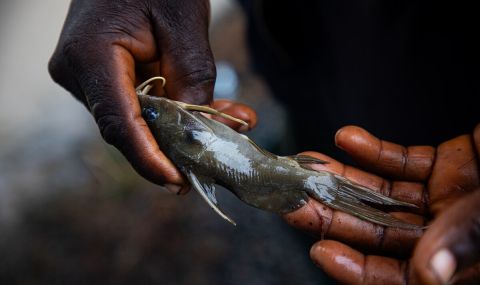
James, a fisherman, reminisces about the days before oil pollution devastated his community of Ophorigbala, Nigeria.
The impact of fishing and climate change on women and girls
While actual numbers of how many women fish and how much they catch5 are not available, according to the Food and Agricultural Organization of UN (FAO) and the World Bank, globally one in two seafood industry workers is a woman.6
On average, 47% of the 120 million people who work in fisheries, harvesting, fish processing and fish trading sectors are women.7 Women constitute a high proportion of workers in subsistence fishing, processing, fresh fish trading and retailing, in environmental organisations, and in administrative work. However, there are very few women in industrial fishing and in leadership positions.8
Women tend to be engaged in small fisheries as opposed to large-scale, industrial fisheries as these are more compatible with their family obligations and demand less in terms of capital.
Women and girls from poorer coastal regions are therefore more affected by the consequences of industrial overfishing9 and climate change as listed above.
Fish is not just a vital food source for women and their families - it contributes to 50% of total animal protein intake in coastal countries in the global south10 - but it plays an important part in the fabric of the coastal culture.
The role of fishing and its associated work helps fishing women and their communities maintain a sense of place, identity and pride in their work and life11.
When fish becomes scarce, families have to fish harder and farther into different territories which takes longer and requires more labour. Children, especially girls, miss classes or drop out of school to help their families fish or take up a larger share of care and household responsibilities while families including mothers go out to fish.12
ActionAid's work supporting responsible fishing
ActionAid works with fishing communities, especially women and girls who have been affected by climate change and exploitative fishing practices through training, support and advocacy.
- When fishing becomes unsustainable as a food and income source, ActionAid helps communities pivot to alternative forms of subsistence and income avenues such as promoting vegetable growth or other types of farming and trade.
- To promote sustainable fishing practices, ActionAid provides training, improved equipment and other resources so that fishing communities can advance their skills while protecting the environment and marine habitats.
- ActionAid also works with local partners to prevent the degradation of local marine ecosystems such as mangroves.
- ActionAid advocates for the rights of traditional fisherwomen to harvest and manage their local fish stocks and empowers women to take leadership roles in the community and challenge the exploitation of their threatened coastland.

Helen, a fisherwoman, reminisces about the days before oil pollution devastated her community of Ophorigbala, Nigeria.
Daniel Jukes/ActionAid
Oil pollution and its impacts on fishing
Ophorigbala, located on the right bank of River Forcados in Ughelli South LGA of Delta State, was once a vibrant commercial fishing hub.
Helen, a fisherwoman in her fifties, remembers when the river sustained families and livelihoods. ‘‘In the past when I come out to fish, I would catch many big fish. There were a lot of fishermen and women in the community and fishing was a booming business here in the community. We could take the fish to other communities and town to sell,’’ she recalls.
Now, oil pollution has devastated the ecosystem. Fish stocks have plummeted, and farmland has lost its fertility. ‘‘But as you can see, I've set my net since morning, and I am yet to catch a single fish. It makes me sad when I inspect my net and find it empty."
The land is no longer fertile for farming, and the river is no longer productive for fishing. It is quite frustrating.’’
For Helen and many others, environmental degradation has not only destroyed livelihoods but also eroded dignity, food security, and hope for the future.

Climate change and its link to gender based violence
Pelekelo (name changed), 49, is a farmer, fish trader, and mother of six. She is a survivor of sex-for-fish exploitation, a practice that worsened as drought reduced livelihoods and bargaining power for women.
When fish became scarce, the pressure increased. Women were left with impossible choices."
With drought declared as a national disaster in Zambia, rural fishing communities in Western Province have faced devastating impacts. As water levels dropped and fish stocks declined, competition over shrinking resources intensified.
For many women, this crisis deepened existing inequalities and exposed them to heightened risks of gender-based violence.
Through the Resilient Inclusive Sustainable Environment (RISE) project, ActionAid Zambia has been supporting vulnerable women in fishing communities since 2023. The project addresses harmful “sex for fish” practices where women are coerced into exploitative relationships to access fish. RISE works to improve women’s access to and control over fisheries resources while establishing safe spaces for survivors.
Today, Pelekelo is a member of her community’s GBV Watch Group and serves as a GBV champion. She supports other women to speak out, seek help, and understand their rights. Through RISE, women like Pelekelo are not only rebuilding livelihoods but also challenging harmful systems that thrive during climate crises.
Person’s name and title of story Pelekelo (not her real name) 49, is a farmer a fish trader and a a GBV champion.Women forced into “sex-for-fish" as drought in decades takes its toll in Zambia .
Loliwe Phiri / ActionAid
Footnotes
- 1https://www.iucn.org/resources/issues-briefs/ocean-warming
- 2https://www.oceanographicmagazine.com/news/mangrove-forests-flood-protection
- 3https://www.theguardian.com/environment/climate-consensus-97-per-cent/2017/feb/16/scientists-study-ocean-absorption-of-human-carbon-pollution
- 4https://www.un.org/sustainabledevelopment/oceans/
- 5https://oceana.org/blog/vital-invisible-how-subsistence-fisherwomen-around-world-feed-their-families
- 6
https://riseseafood.org/topics/women-in-seafood/?utm_source=chatgpt.com
- 7
https://thefishsite.com/articles/the-role-of-women-in-the-seafood-industry?utm_source=chatgpt.com
- 8
https://www.fao.org/newsroom/detail/Angling-for-gender-equality-in-the-seafood-industry/ar?utm_source=chatgpt.com
- 9https://www.dw.com/en/the-women-left-to-face-climate-change-and-overfishing-alone/a-47709246
- 10https://thefishsite.com/articles/fao-state-of-world-fisheries-aquaculture-report-fish-consumption
- 11https://www.sciencedirect.com/science/article/pii/S2212682116300336
- 12https://practiceconnect.azimpremjiuniversity.edu.in/the-education-of-children-from-fisher-communities-lessons-from-indonesia-india-and-brazil/
Page updated 12 February 2026