HIV and AIDS
36.7 million
There were approximately 36.7 million people living with HIV at the end of 2016.3
25.6 million
Africa is the most affected region, with over 25.6 million people living with HIV in 2016.4
58%
58 per cent of new HIV infections among young persons occurred among adolescent girls and young women.5
Are women disproportionately vulnerable to HIV?
Deep-rooted gender inequality makes women and girls disproportionately vulnerable to being infected with HIV. It also undermines efforts to prevent AIDS.
In sub-Saharan Africa, young women (15-24 years) account for 75 per cent of HIV infections and are approximately three times more likely to be infected than young men of the same age.6
Studies from Rwanda, Tanzania, and South Africa show up to three fold increases in risk of HIV among women who have experienced violence compared to those who have not.7
Five key links between HIV and violence against women and girls
The World Health Organisation identifies five key links between the two, showing how violence against women and girls, particularly domestic violence by intimate partners, is both a cause and a consequence of HIV infection.
- Inability to negotiate condom use: domestic violence from intimate partners exacerbates unequal power in sexual relationships making it difficult for women and girls to negotiate condom use to protect themselves from HIV infection.
- Violence as a consequence of being HIV positive: domestic violence or fear of violence in intimate partner relationships can prevent women seeking HIV testing and revealing their HIV status. This limits their access to vital services such as antiretroviral treatment (ART), prevention of mother-to-child transmission, and psychosocial support.
- Relationships with older men: child marriage - the practice of young girls being married to much older men - increases the risk of infection, because older men have a higher prevalence of HIV. The age gap also amplifies the unequal power dynamic, increasing the likelihood of numbers one and two.
- Direct transmission through sexual violence: the greater the trauma, vaginal lacerations, and abrasions, caused by the level of force used by the perpetrator, the greater the risk of HIV transmission.
- Sexual risk taking: studies show that women’s experience of violence is linked to them having multiple partners, partnerships outside marriage and engaging in transactional sex, all of which increase the risk of getting HIV.

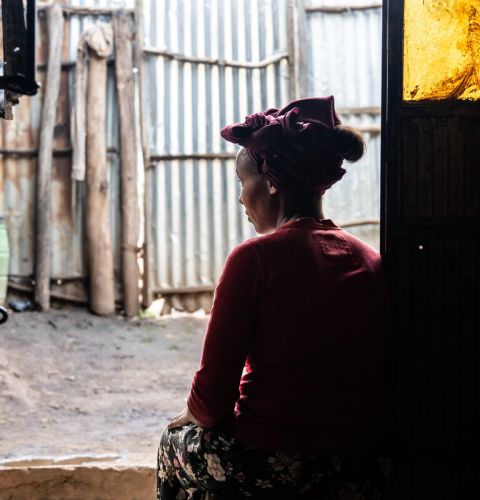
With ActionAid’s support, Hana rebuilt her life, gained confidence, and now teaches others about HIV and hope.
Genaye Eshetu/ ActionAid
Reducing the stigma around HIV
Hana, a survivor supported through ActionAid’s combatting modern slavery project in Ethiopia, faced a period of extreme hardship, reduced to begging for survival. Her life took a turn when she received seed money from ActionAid, enabling her to start rebuilding her life.
“I am indebted to ActionAid. This opportunity came at the right time for me, when I was down and had been reduced to begging. When I heard about the seed money I didn’t believe it to be true, until the money was in my hands, because I’d never seen this much money before,” Hana recalls.
Beyond economic support, ActionAid provided vital education on health and HIV, empowering Hana to take control of her life and share her knowledge with others.
I’m so thankful because they gave me hope when I had lost all hope. Now I have hope, I want to teach people that they can do anything in life. I want to teach people about HIV because I know so much more about it now."
Through this combination of economic support and health education, Hana has transformed her life and become a source of knowledge and inspiration for her community, showing how integrated support can empower survivors to overcome vulnerability and lead positive change.
HIV and child-headed households
High prevalence of HIV/AIDS causes a huge increase in child-headed households - houses where a child under 18, usually the eldest, has become the head of the household. This is mostly because both parents have died, often due to conflict or disease.
The eldest children often have to drop out of school and find a way to earn money. This makes young girls even more vulnerable to sexual violence.
In Kenya, Homa Bay County has the highest rate of HIV/AIDS in the country, with an HIV prevalence rate of over 25%.
In some areas of Nyarongi, where ActionAid works, whole generations have been wiped out by HIV/AIDS, leaving young girls heading up families with no means to support them.
The local sugar factory attracts thousands of male workers from across the country. Girls, many of whom are child heads of households, are lured into sex by older boys and men in exchange for items like school uniforms, sanitary towels, food, or the promise of ‘a better life’.
This puts girls at risk of HIV infection, showing again how violence against women and girls is both a cause and a consequence of HIV.
How ActionAid supports women affected by HIV
Through supporting local women's groups ActionAid provides vital information, including how to prevent infection, how to get tested, how to get treatment and how to prevent mother-to-baby transmission.
We provide psychosocial support to help women cope with the stigma of living with HIV, and help change negative attitudes in communities.
Through our skills training and group projects we empower women to earn their own income, helping them afford antiretroviral treatment, and support their children.
All of our work to end violence against women and girls – such as helping stop child marriage and ensuring perpetrators are held to account – also helps reduce the risk of women and girls being infected.

With ActionAid’s support, Sindu accessed vital medical care, financial aid, and hygiene kits, helping her recover and rebuild her life.
Hailu Nurga/ActionAid
How ActionAid helps survivors of violence and HIV - Sindu's story
Sindu, 43, a mother of six, faced unimaginable violence during the conflict in Northern Ethiopia. Divorced before the war, she was living in Chelena when, in February 2021, she was raped by two soldiers amid escalating attacks in her town.
“On that day, I became faint and was unconscious for many days… we saw them killing so many young people in town and we were highly afraid they might kill us,” Sindu recalls. Her 14-year-old son fled for safety and later took her to Maichew Hospital, where she began recovery.
Following the attack, Sindu was diagnosed with HIV, TB, and fistula. “I stayed for about 45 days in Maichew hospital. Now I am cured of TB, taking ART for HIV, and referred for fistula care,” she explains. The support she received from ActionAid Ethiopia was vital for her survival and recovery. Cash support of 7,065 birr (≈£97), hygiene kits, and medical support allowed her to cover transportation, food, and start petty trade, easing both financial and emotional burdens.
I am happy that the cash distributed by ActionAid Ethiopia reached us during our stressful conditions."
Today, Sindu is regaining her independence, rebuilding her life, and taking steps toward stability for herself and her children.
Footnotes
- 1
https://www.unaids.org/en/resources/documents/2024/2024-unaids-global-aids-update-adolescent-girls-young-women
- 2WHO (2017), HIV/AIDS Fact sheet.
- 5SAFA.
- 6UNAIDS (2004). Report on the global AIDS Epidemic: 4th global report. June 2004. Geneva, Switzerland.
- 7WHO, Violence Against Women and HIV/AIDS: Critical Intersections, Information Bulletin Series, Number 1, p.1.
Page updated 8 September 2026