Climate change and poverty
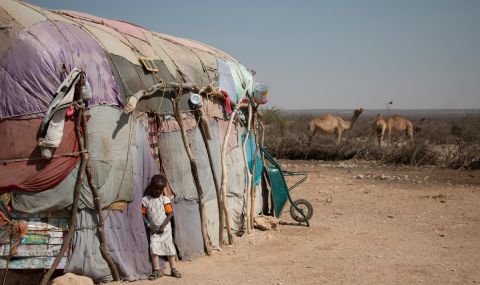
Makeshift homes built in the desert in Somaliland, which has been pushed to the brink by climate change .
The relationship between climate change and poverty
Despite historically being the least likely to contribute to rising CO2 emissions, people living in poverty are often the worst affected.3
Meanwhile, many of the world’s richest and highest-polluting countries are feeling the impact of climate change the least.2
Richer countries tend to have the resources and networks to adapt to the changing climate, and more resilient infrastructure (such as water systems and housing) to cope with erratic weather events and disasters.
While poorer countries almost always have fewer resources and weaker infrastructure, making them more vulnerable to the effects of climate change.
Climate change and agriculture
Families for whom resources are already scarce are facing a worsening battle against poverty every day.
And for those who rely on farming for income and food, the effects are particularly stark. Poor land management policy and unsustainable development is causing the degradation of land, including soil erosion and desertification, which is speeding up negative effects of climate change. And higher temperatures, changing rainfall patterns and increased water scarcity are making vast regions of land unsuitable for food production.4
Over 1.3 billion people, mostly in developing countries, are currently trapped on degrading agricultural land, increasing their vulnerability to slow-onset disasters such as drought, desertification, food insecurity and even famine.5
And in the future, climate change threatens to wreak havoc on many more lives. It is estimated that up to 600 million more people in Africa could face malnutrition as agricultural systems break down due to climate change impacts. An additional 1.8 billion people could face water shortages, especially in Asia.6
How climate change deepens inequality
Climate change is not just shining a light on the world’s inequalities; it is often deepening those inequalities themselves.
When disasters strike, it is those with less power and fewer resources who invariably suffer the most. But they also exacerbate poverty, because those most affected by drought or floods must sell their land or livestock at low prices, effectively transferring assets from the poor to the wealthy.7
70%
of the world’s poor depend on natural resources for all or part of their livelihoods 8
600 million
An estimated 600 million more people in Africa could face malnutrition as agricultural systems break down due to climate change impacts 9
1.8 billion
An additional 1.8 billion people could face water shortages, especially in Asia 10
ActionAid's work supporting people affected by climate change
ActionAid is working with communities across the world to develop solutions that help people adapt to the impacts of climate change, respond to disasters, and build resilience to climate change related extreme weather patterns.
This includes:
- Training women and children on how to prepare for cyclones and protect lives and livelihoods
- Supporting farmers with climate-resilient crop seeds and farming methods
- Supporting the building of flood-resilient villages.
We’re also supporting the specific needs of women and girls affected by climate change.
At times of crisis, marginalised people are forced into negative coping mechanisms to survive. For example, girls can be forced to drop out of school or to be married earlier, as their families are no longer able to afford to house or feed them.
That’s why we work with grassroots women’s networks to empower women and girls to stay in school, get the education they deserve and claim their rights.
Across the world, we’re also working with local partners to pressure governments around the world to take more radical action on climate change. We know that, to prevent the worst effects of climate change, governments, donors, climate and humanitarian agencies must work together and take urgent action.

Esnert Thaison, 45, stands in front of her submerged crop in Malawi
Fletcher Simwaka/ActionAid
Extreme weather and poverty
Tropical Storm Ana destroyed lives, houses and property throughout Madagascar, Malawi and Mozambique in 2022.
Esnert Thaison in Malawi lost the crops she planted due to the flooding that followed the storm. The mother of eight now has to gut fish in order to provide for her family.
"Gutting 50 kgs of fish is a backbreaking task; it takes me almost half of the day. But since I need money to buy food for my children, I still must do it," she says. She is paid just K1000 (£0.90) for each 50 kilograms of fish she guts.
Some women in the area were forced to resort to sex work in order to, but Esnert is determined not to go down that path.
I vowed never to indulge in sex work, no matter how tough the situation is."
Esnert is just one of thousands of women who have lost their livelihoods due to extreme weather disasters around the world.
Footnotes
- 1
https://news.un.org/en/story/2019/06/1041261
- 34 H Singh. Solving the climate crisis means tackling global inequality (2015) [Online]. Available: http://news.trust.org/item/20150525141853-ld051/. [Accessed 29 August 2018].
- 2https://news.un.org/en/story/2019/06/1041261
- 4https://www.un.org/development/desa/dspd/wp-content/uploads/sites/22/2018/05/9.pdf
- 5https://www.un.org/development/desa/dspd/wp-content/uploads/sites/22/2018/05/9.pdf
- 6https://www.undp.org/content/undp/en/home/librarypage/poverty-reduction/mainstreaming-environment-and-climate-for-poverty-reduction-and-.html
- 7https://policy-practice.oxfam.org.uk/publications/el-nino-the-case-for-urgent-action-583920
Page updated 28 January 2026